
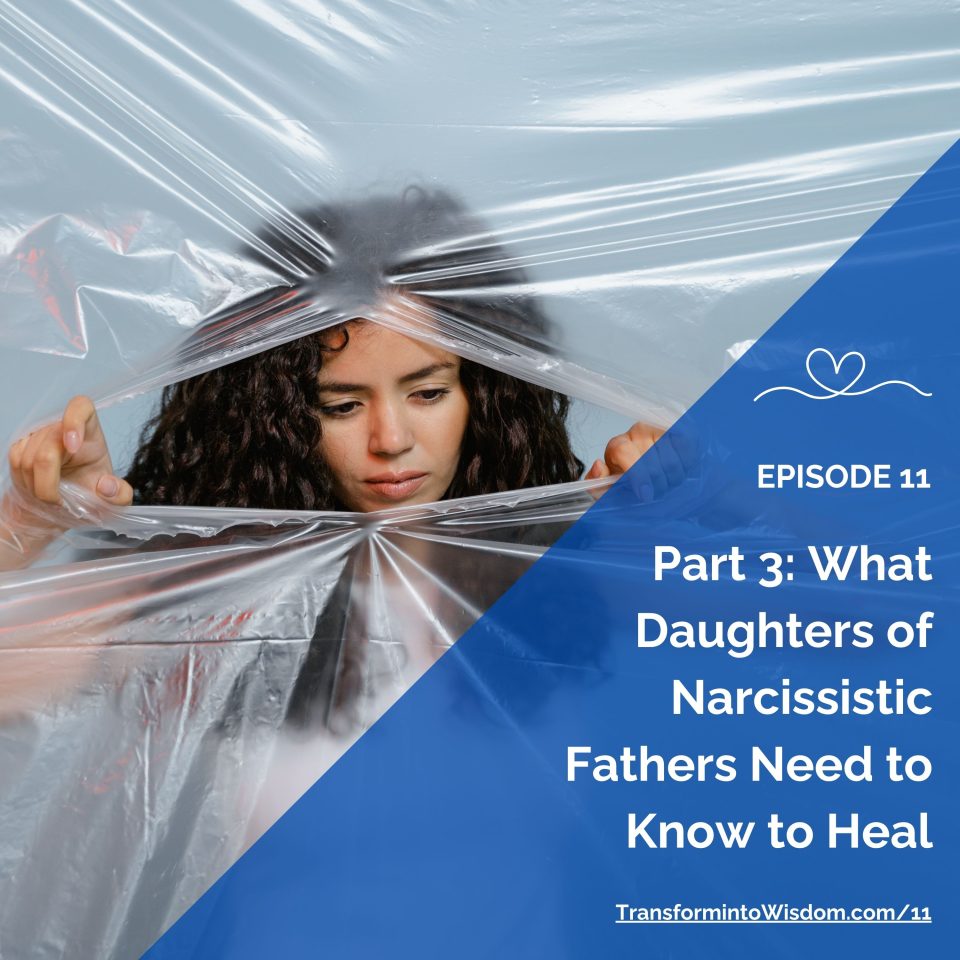
Today, we’re continuing our deep dive into what daughters of narcissistic fathers need to know—this is Part 3 of the series.
Why does this matter so much?
Because if you’ve found yourself in a narcissistic relationship later in life… it didn’t just start there. It started somewhere much earlier. Somewhere closer to home.
And in many cases, it started with him—your father.
And that means… it didn’t start with you.
You are not the source of your wounding.
You didn’t break yourself.
This didn’t come out of nowhere.
By gently tracing back to the beginning—by examining what happened and also what didn’t happen—you begin to reconnect with what’s true. You begin to see your story clearly.
And from that place of clarity, you begin to heal.
So, let’s go deeper into the third layer of harm—what I call the active and passive harm from a narcissistic father.
Part 3: The Active & Passive Harm from a Narcissistic Father
In episode 9, we explored physical violence.
In episode 10, we talked about the emotional unsafety and the intentional infliction of harm.
And now, we continue with the next layer:
3. Chronic Criticism from a Narcissistic Father
Maybe your father criticized more than he comforted.
And over time, you may have started shrinking yourself just to survive.
- You learned not to make mistakes.
- You learned to stay small and invisible.
- You may have believed that love is something to be earned through being perfect.
And so, perfection became your protection.
He may have demanded attention for himself but gave you very little in return.
And so, without even realizing it, you learned;
- To under-receive.
- To crave affection… quietly.
- To long for someone—anyone—who would finally see your worth and offer you the attention you always deserved.
Even when you did succeed, maybe he found a way to dim your light, to make your achievements seem small, to withhold praise or to redirect the spotlight back to himself.
And when others—friends, mentors, even strangers—celebrate you more than your own family does… it can leave this aching question in your heart:“Why didn’t they see me? Why didn’t he?”
This kind of chronic criticism leaves a mark
The Root of the Inner Critic
It erodes your self-worth. It silences your voice. It makes you second-guess yourself, even in moments when you know you’re right. You start wondering, “What if he was right all along?”
You begin to question your own instincts.
And sometimes, you even try to change who you are—to become someone more acceptable—just to avoid being a target.
Because every child wants to be accepted.
So, you learned to stay one step ahead of his moods…
You became hyper-attuned.
You tried to be good.
You tried to be quiet.
You thought:
“If I can just be perfect, maybe I won’t get attacked…”
“If I don’t have needs, maybe I’ll be safe…”
And somewhere along the way,
His voice became your inner voice.
So now…
You might be harsher with yourself than anyone else would ever be.
You might feel stuck in decision-making.
Not because you don’t know what you want…
but because you hear his voice in your head saying,
“That’s stupid.”
“You’ll fail.”
“Who do you think you are?”
That voice… doesn’t belong to you.
But it lives inside you now.
And I want to pause here… because this is where the emotional repair begins.
To really show the emotional impact of words and intention—not just psychologically but energetically—I want to share two symbolic experiments. Not for their scientific contribution/validity, but for what they represent on an emotional level.
The Water Experiment:
Dr. Emoto exposed water samples to different words, music, or intentions, then froze the water and photographed the crystals that formed.
- When the water was exposed to positive words like “love” or “gratitude” or classical music, it formed beautiful, symmetrical crystals.
- When exposed to negative words like “you fool,” “I hate you,” or heavy metal music, the crystals were chaotic, distorted, or failed to form at all.
Key Insight:
Emoto believed that water is sensitive to vibration, and since the human body is over 70% water, words—especially repeated or emotionally charged ones—can impact our internal state profoundly.
The Plant Experiment
A school experiment inspired by Emoto’s work was conducted by IKEA in the UAE in 2018 to raise awareness about bullying.
- Two identical plants were placed side by side in the same environment.
- For 30 days, students were instructed to praise one plant and bully the other, using pre-recorded messages.
- Result: The praised plant thrived. The bullied plant showed signs of wilting and stunted growth.
How This Connects to Chronic Criticism:
Chronic criticism—especially from a parent or authority figure—is like constantly exposing a developing nervous system (like a child’s) to negative “vibrations”:
- It weakens self-trust.
- It distorts one’s internal narrative.
- It can stunt emotional growth—just like the bullied plant.
Even if Emoto’s research is considered controversial in scientific circles, the symbolism is powerful and resonant—especially as a sensitive soul.
4. Emotional Reversal & Loyalty Conditioning by a Narcissistic Father
Narcissistic fathers often condition their daughters to take emotional responsibility for them. This might be through minimizing his outbursts—rationalizing and excusing harmful behavior.
Your father may have blamed you for his angry outbursts or even physical threats, and you absorbed the blame for not being a “good girl.”
Another way of loyalty conditioning is to keep family secrets at all costs to avoid “airing dirty laundry” in public. You have been conditioned to protect his image at the expense of your truth. Over time, protecting him becomes a survival strategy.
You maintained his emotional stability and the illusion of goodness to avoid conflict, abandonment, or shame.
The Psychological Effects of Emotional Reversal & Loyalty Conditioning
The psychological effects of this conditioning lead to
- Parentification: You became the emotional caretaker, regulating moods in the household while your own needs as a child were ignored or punished.
- Trauma bonding: His occasional approval or praise keeps you emotionally invested and attached to him, hoping that you can “earn” more love.
If you look at it through the classical “Pavlovian conditioning”:
- Unpredictable reinforcement (occasional praise, attention, or love) becomes the “treat.”
- The nervous system learns to associate emotional highs (affection, approval) with the person causing emotional pain.
- Even though they hurt you, your brain starts to crave their rare moments of kindness—just like Pavlov’s dogs salivating for the bell, hoping food will follow.
- False guilt: Where you may feel selfish for speaking the truth against his behavior. There is a core belief that is developed, which is “If I can protect him, maybe he’ll love me. Maybe he will finally see me. Maybe things won’t be so bad.” And this core belief is present in narcissistic relationships as well. “Maybe better the devil I know.”
In a narcissistic relationship, the same threads follow. If in your family of origin and your father:
- You were trained to protect his image, even when he hurt you—you will do the same with a narcissistic partner.
- Speaking about him honestly was labeled as disrespect, betrayal, or exaggeration—you will do the same with a narcissistic partner.
- You internalized the belief that your silence was a virtue—you will do the same with a narcissistic partner.
Gentle Crucial Lessons to Remember
If your body feels tight right now… or your heart feels heavy… that’s okay.
This work goes deep.
And when we start to name the harm that once had no name—when we speak into the silence—we begin to reclaim something.
We begin to reclaim ourselves.
And I want to gently remind you:
You were never meant to carry the emotional weight of your father’s dysfunction.
You were never meant to earn love by disappearing yourself.
You were never meant to protect someone who didn’t protect you.
This pain you’ve carried wasn’t proof that you were broken—it was a sign of how deeply you needed love, stability, and truth… and how little of it you were given.
But now… you’re remembering.
You’re seeing things clearly.
And in that clarity, healing becomes possible.
So, take a moment—just one breath—to be with yourself.
Right here. Right now.
Feel the weight of your truth in your body.
And know that this unraveling is not falling apart.
It’s sacred repair.
Invitation to Reflect
As you move through the rest of your day, I invite you to reflect on this question:
“Where in my life am I still carrying the emotional weight of someone else’s dysfunction—and what would it feel like to put it down?”
You don’t have to know how yet.
Just begin by noticing.
Because noticing is where the healing begins.
In our next episode, we’ll continue exploring more layers of harm—including how gaslighting, image management, and emotional neglect create confusion, self-doubt, and the long-term effects that can follow you into adulthood.
This series isn’t just about the pain. It’s about understanding the patterns so you can break free from them—and come home to yourself.
So, take what you need from this episode. Be gentle with your inner world. And remember:
You were never too much.
You were just in an environment that asked you to be less.
And now…
You get to choose something different.
I’ll see you in Part 4.