Ep 25 — Why Did I Fall for a Narcissist? — The Sensitive Soul and the Soulmate from Hell
There is a story that has stayed with me for a long time.
In Australia, a husband killed his own son. His wife was arrested alongside him — and when the police asked her what happened, she refused to tell them the full story. She stayed silent. She protected him. Even then. But not for long.
One of the comments on the video asked the exact question I had been sitting with myself:
How can a mother — a woman who says she loves her son, who is visibly devastated, who is grieving — how can she side with a man who is essentially a stranger over her own flesh and blood?
It is the kind of question that hits to the core for many people who experienced childhood trauma. And the answer is too uncomfortable to sit with.
Years later, she answered it herself. In one sentence.
“Because I was afraid of being alone.”
That is what an unconscious need looks like when it is fully exposed. Not evil. Not indifference. Not a lack of love. It is Fear. A fear so deep, so old, so woven into the nervous system, that it overrides everything — including the most sacred bond a human being can have.
Today we are going into that territory. The unconscious needs that drive our decisions. The childhood wounds — not always the obvious ones, but also quiet ones, the forgotten ones — that prime the nervous system long before the narcissist ever arrives.
What Happened to You? Enduring Childhood Trauma
Before we go into what was missing, we need to acknowledge what was present — because for many sensitive souls, both things are true at the same time, and the confusion between them is part of what makes the wound so difficult to see clearly.
Childhood trauma is not rare. It is not something that happens to a small number of people in extreme circumstances.
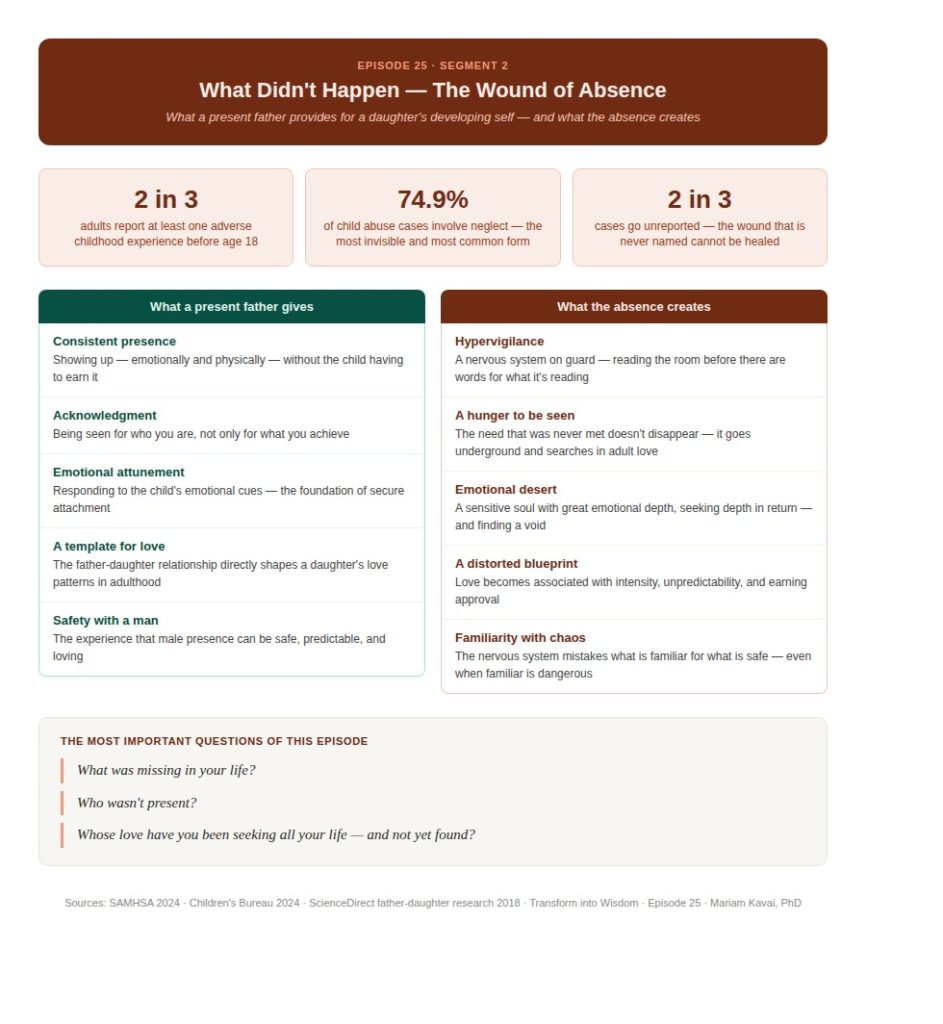
Nearly two thirds of adults in the United States report having experienced at least one adverse childhood experience before their 18th birthday. More than two thirds of children globally encounter at least one traumatic event by the age of sixteen — SAMHSA, 2024. Approximately two thirds of child abuse cases go unreported. What we count is only a fraction of what exists.
But I am not here today to talk about statistics. I am here to talk about your story. And I want to share some of mine — because I believe that healing happens fastest when truth is spoken out loud, in community, without shame.
I have shared on this podcast before that I grew up with a father who was an alcoholic and a narcissist. For the first eighteen years of my life, I experienced verbal, physical and emotional abuse. My father was also emotionally unavailable as is the case for many people with narcissistic traits — and yet he was also my father, and I loved him.
Two things can be true at the same time. We loved him deeply, and we were also scared of him. That was the reality for my siblings and me — and especially for my brother.
My father was a strict disciplinarian who, in his apology letter to me — which I received years later — acknowledged that he didn’t know what he was doing. That he was never been taught how to raise a family. That no one corrected him or showed him the way. And he acknowledged that I had endured the worst of his excesses.
And if you were the daughter of a narcissist, you will know what I mean when I say that the harm was not always loud or dramatic. Sometimes it was the gaslighting. The manipulation. The way love was conditional and confusing and never quite enough.
The way you learned to read the room before you had words for what you were reading. The way everyone was always catering to his needs before your needs and so you learned to cater to other people’s needs before your own. To become “Other” focused.
The way he sucked out all the oxygen in the household and would create a scene if he didn’t get the attention that he felt entitled to. There is so much more that you can fill in that I haven’t captured.
That is what happened. And it matters. It shaped the nervous system that carried you into adulthood and into love.
But here is what I discovered as I went deeper into my own inner work. There was something even bigger underneath the thing that happened.
It was what didn’t happen.
What Didn’t Happen to You? The Invisible Childhood Trauma
There is a particular kind of wound that is hardest to name. Not the wound that was made by what happened — but the wound that was made by what didn’t. The absence. The gap. The things that should have been there and were not.
Research on the father-daughter relationship gives us a precise picture of what a present, emotionally available father does for a daughter’s developing self.
Paternal sensitivity — a father’s ability to perceive and respond to his daughter’s emotional cues — is foundational for secure attachment formation. Research confirms that the father-daughter relationship is a primary factor in shaping a daughter’s love and work style in adulthood. Source: ScienceDirect, 2018; PMC research, 2022.
A healthy father provides presence. Acknowledgment. The experience of being seen and heard without having to earn it. He gives positive reinforcement — not just for achievement, but for being. He offers emotional depth, consistency, and the steady message that love is not something you have to perform to deserve.
Childhood Emotional Neglect & the Wound of Absence
What did I miss? What was the absence that shaped me?
Presence. Consistent, safe, unconditional presence. Acknowledgment — the simple experience of being seen not for what I did, but for who I was. The kind of emotional depth that a sensitive soul craves, and that creates a particular kind of hollowness when it is withheld.
And here is something I want you to sit with — because it may be the most important question of this entire episode:
What was missing in your life? Who wasn’t present? Whose love have you been seeking all your life — and not yet found?
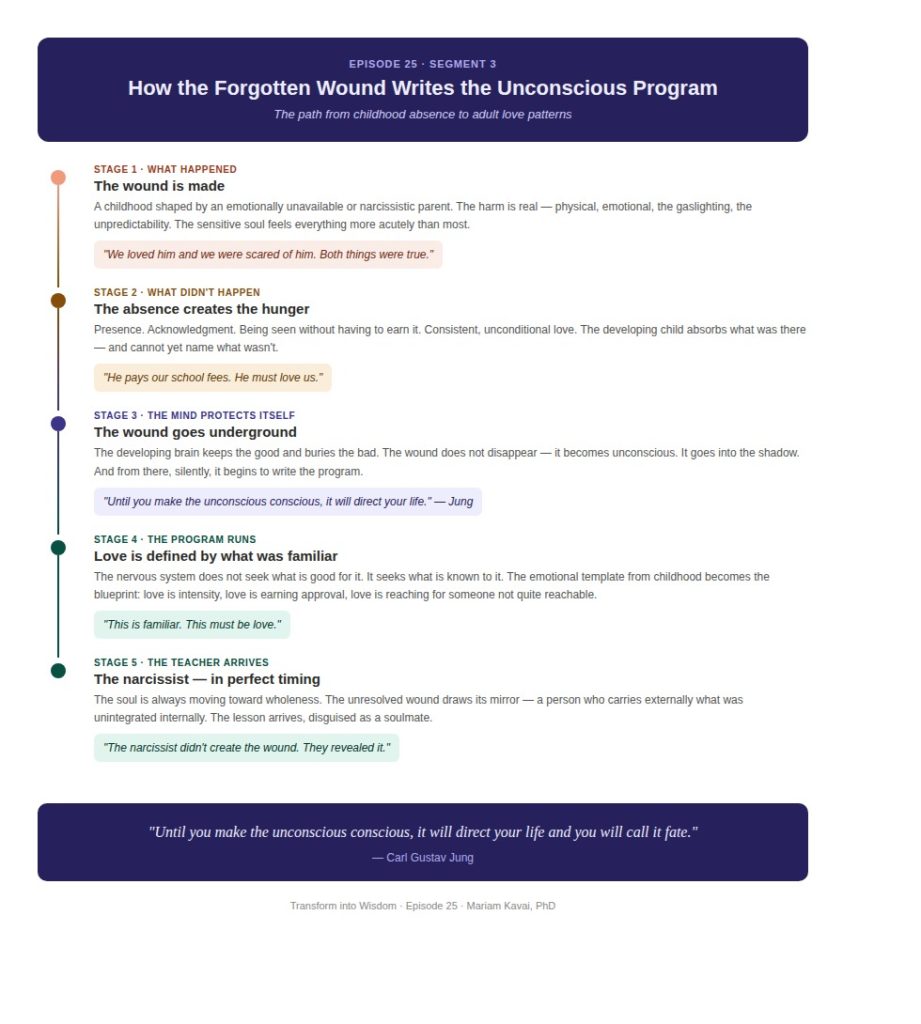
Because the mind of a child cannot hold both truths at once. The developing brain absorbs what happened but cannot fully process it. So, it does the only thing it can do. It keeps the good and buries the bad.
“He pays our school fees — he must love us. He comes home for dinner — he must love us. He stayed with our mother all these years — surely he must love us. Even if he yells. Even if he frightens us. Even if we walk on eggshells around his moods. He means well. He is doing his best.”
And there is also, for many of us, the layer of religious teaching — forgive those who have wronged you, spare the rod and spoil the child — teachings that created a complex tangle in the psyche.
As a child, how do you honor your father and also name your pain? How do you forgive and also grieve what was taken from you? You don’t know any of these things. Grief is too much for a child. So, you forgive and you say you know maybe God wants me to forgive.
I remember many times when I was hurt by parents I understood to the depth of my core that these people didn’t know what they were doing. Because if they knew what they were doing, the repercussions, the ripple effect, if they understood the pain I felt, they would never do it again.
And my prayer was always “Forgive them father because they don’t know what they are doing.” The idea that my parents were horrible people incapable of love was too terrifying to me. I just thought it’s the situation. Maybe something I did. Maybe something happened.
But I could never keep both the good and the bad at the same time. So, I always forgave or just avoided that part in order to move on.
So, the bad goes underground. Not because you chose to forget it — but because the mind was not yet built to carry it consciously. The wound becomes unconscious. It goes silent. It goes into the shadow.
And from there — quietly, invisibly, with devastating precision — it begins to write the program.
The Forgotten Wound: How It Writes the Unconscious Program
Carl Jung understood something about the human psyche that most of us spend our entire lives trying not to know.
He believed that within each of us exists a shadow — the repository of everything that was too painful, too unacceptable, too complicated to hold in conscious awareness. The things we pushed down not because they were not real, but because we did not yet have the capacity to integrate them.
“Until you make the unconscious conscious, it will direct your life and you will call it fate.”
— Carl Gustav Jung
The shadow is not evil. It is the place where the unprocessed truth lives — the grief that was never mourned, the need that was never met, the love that was asked for and not received. And the shadow does not stay still. It moves through us.
It speaks through our choices, our patterns, our attractions, the relationships we enter without fully understanding why.
The forgotten wound becomes the unconscious program that runs beneath the surface of every adult decision about love.
Who did I learn that love was? Someone whose presence was unpredictable. Someone whose approval I had to earn. Someone who was capable of a little warmth and also capable of withdrawal, of rage, of emotional distance.
Someone I could never quite reach — no matter how hard I tried. Someone who’s needs come before my own. Somone who is jealous, overreacts and then apologizes then withdraws. Someone who is distant. Someone who is charming, superficial, loves sports and politics.
Someone who is an alcoholic because sober people are boring. Love is sacrificing what I truly feel to make the peace. Someone who’s moods I learned to read before I knew my own. Somone who needed me to be the grown up.
And so, the program was written love feels like this: Love is something you work for. Love is intensity followed by withdrawal. Love is trying to earn the approval of someone who withholds it.Love is reading the room before I feel my own feelings.
Love is being responsible for someone else’s moods. Love is needing the apology more than I need to be safe. Love is the relief when the rage finally passes. Love is conditional. Love is choosing the danger I know over the calm I don’t. Love is the devil that I know.
Love is familiar — even when familiar is dangerous. Especially when familiar is dangerous.
The nervous system does not seek what is good for it. It seeks what is known to it. And what was known — what was wired in through thousands of early experiences — was the emotional template of a person who could not fully show up.
This is not your fault. This is how the psyche works. This is how the wound, when it is not yet seen, becomes the compass, that gives your life directions. And if you have ever created a flow chart or seen one, this is the template that is running your life. Just like a Windows operating system or MacOS.
It is the foundation of everything about you.. When a virus enters your computer, it doesn’t immediately alert you. It creates a hidden folder and then it changes the system files one by one. Weird things start happening, your computer becomes slow and if the attack is severe, your computer becomes inoperable.
Our mind is a computer, and our childhood trauma is like a virus. {Healing means going to the core and changing the operating system at the core, removing hidden virus files and codes that have corrupted your system and changed system files so that the computer can start running again faster and better than before}
When the Narcissist Returns: When the Student Is Ready, the Teacher Appears
I want you to hold a different frame for a moment. Not a therapeutic frame. Not a clinical one. A wider one.
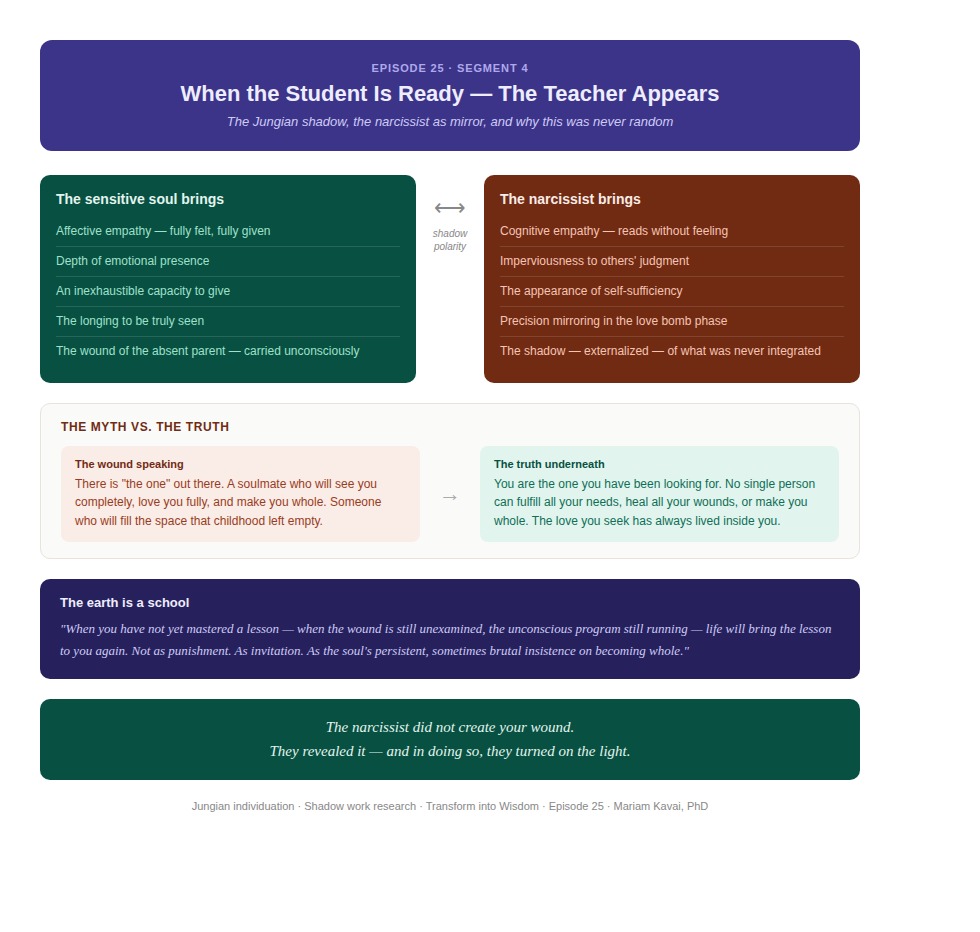
The earth is a school. And in this school, when you have not yet mastered a lesson — when the wound is still unexamined, the unconscious program still running — life will bring the lesson to you again. Not as punishment. As invitation. As the soul’s persistent, sometimes brutal insistence on becoming whole.
Jung described individuation as the lifelong process of integrating the conscious and unconscious aspects of the psyche — of becoming, as he put it, a separate and whole individual. Not a perfect one. A whole one.
The shadow, Jung believed, must be confronted before wholeness is possible — and it is almost always encountered first in projection onto another person.
What does that mean for the sensitive soul?
It means that at a certain point in your development — in perfect timing, as though arranged — you meet someone who carries, in their very being, the unresolved wound from your past. Someone who feels familiar in a way that bypasses reason. Someone who activates the same hunger that your childhood left unfed.
The narcissist does not arrive randomly. They arrive as the shadow made flesh. They carry, externally, the very qualities you never integrated internally — the certainty, the imperviousness, the apparent self-sufficiency, the emotional unavailability that your nervous system learned to call love.
And you are drawn to them not despite these qualities, but because of them. Because something in you recognizes the shape of this wound. Because the soul, in its relentless movement toward wholeness, has arranged for the lesson you have been avoiding, to come and sit across the table from you.
“The most terrifying thing is to accept oneself completely.”
— Carl Gustav Jung
There is also the story you were told — the story that so many sensitive souls absorbed without ever examining. That somewhere out there, there is the one. A person who will see you so completely, love you so fully, that the old wound will finally close.
A prince charming who will arrive and make sense of everything that was broken. A soulmate who will complete you.
This story is not a truth. It is a wound wearing the costume of hope.
Because what the sensitive soul is actually searching for — beneath the longing for the perfect relationship, beneath the hunger for someone who will finally see them — is the love that was missed in childhood. The presence that was not there. The acknowledgment that never came.
And the narcissist, in the love bombing phase, performs this so convincingly that the nervous system registers it as the answer to a question it has been asking its entire life.
But the narcissist is not the answer. The narcissist is the question — brought into form so that you can finally see it clearly enough to ask it of yourself.
When the student is ready, the teacher appears. And sometimes the teacher is the most painful relationship of your life — precisely because the lesson it carries is the one you needed most.
The soul is always calling you toward wholeness. The wound was always pointing toward the light. And the relationship that broke you open — as devastating as it was — was also, in its terrible way, in conversation with the deepest part of who you are becoming.
Putting It All Together: Why Did You Fall for the Narcissist?
Let me draw the full picture for you now — because I want you to be able to hold all of this together, not as separate pieces of information, but as one coherent story. Your story.
You were born a sensitive soul. Your nervous system — as we explored in Episode 24 — is biologically wired for depth. Your mirror neurons are more active. Your insula registers the emotional climate of every room you enter.
You process stimuli more thoroughly, feel more completely, absorb more fully than most people around you. That is your design. That is your gift.
And then life placed that gift into a container that could not hold it safely. A parent who was not fully present. A childhood shaped by what happened — and equally, profoundly, by what didn’t.
The absence of consistent emotional presence. The hunger to be seen that was never fully fed. The need for love that was offered conditionally, if at all.
The developing mind could not process this fully — so the wound went underground. Into the shadow. And from there, it wrote the unconscious program: love looks like this. Love feels like this. This intensity, this hunger, this reaching for someone who is not quite reachable — this is what love is.
And then you grew up. And your extraordinary nervous system — designed to attune, to absorb, to attach deeply — carried that program into every relationship. And at a certain point, in perfect timing, the lesson arrived in the form of a person who felt, from the very first moment, like something you had been waiting for your whole life.
They weren’t wrong. You had been waiting. But not for them specifically. For what they awakened in you. For the wound they made visible. For the question they forced you to finally ask.
The narcissist did not create your original wound. They revealed it.
They walked into the room where the forgotten wound had been waiting in the dark — and they turned on the light.
That is not a small thing. That is, in the deepest sense, the beginning of everything.
Closing
Underneath all toxic relationships — for the sensitive soul — lives a constellation of fears that most of us have never said out loud.
A deep fear of abandonment. A fear of being alone. A fear of living without partnership — without being chosen, without being loved. And a belief, absorbed so early that it feels like truth: that somewhere out there, the one exists. The person who will make you whole. The love that will finally be enough to fill the space that childhood left empty.
I want to tell you something now that I want you to receive not as a platitude, but as the most important thing I know:
That person does not exist. Not because love is not real. Not because partnership is not beautiful. But because no single human being on this earth has the capacity to fulfill all of your needs, heal all of your wounds, and make you whole. To believe they can is to place on another person a burden that belongs only to you.
The true love you have been searching for — the one who sees you completely, who is always present, who will never abandon you — is not waiting for you in another person.
It is waiting for you in yourself.
You are the one you have been looking for. You always were.
And the work of this lifetime — the sacred, difficult, extraordinarily worthwhile work — is to stop searching for that love in places that cannot give it, and to begin turning toward the one place it has always lived.
The wound brought you here. The fear brought you here. The relationship that broke you open brought you here. And here — in this moment of understanding, in this willingness to look clearly at what happened and what didn’t — is where the real healing begins.
In our next episode, we ask the question that sits underneath everything we have explored today: why does the narcissistic abuse hurt so much? The answer lives in the depth of the wound itself — and understanding it is one of the most liberating things a sensitive soul can know.
I cannot wait to share that with you.
If something in today’s episode stirred something in you — if you found yourself nodding, or pausing, or sitting with something you have never quite had words for before — I want you to know that there is a next step. Not therapy. Not starting over. A structured way to rebuild, with someone who understands what you are carrying. Come find me. I would love to hear from you.