Ep 21 — What Actually Heals Narcissistic Abuse? Why Understanding the Abuse Isn’t the Same as Healing the Wound
The Lie: Understanding the Abuse = Healing the Wound
There’s this lie that floats around in trauma recovery spaces — especially in narcissistic abuse recovery.
This belief that if you just understand it, you’ll finally be free.
If you can trace the trauma, name the disorder, and decode the narcissist’s mind — then maybe the pain will loosen its grip.
And it sounds reasonable, doesn’t it?
We live in a culture that worships knowledge. Watch enough videos, listen to enough experts, study the psychopathic mind, the narcissistic mind, the deviant mind — and maybe, finally, you’ll outsmart the ache inside.
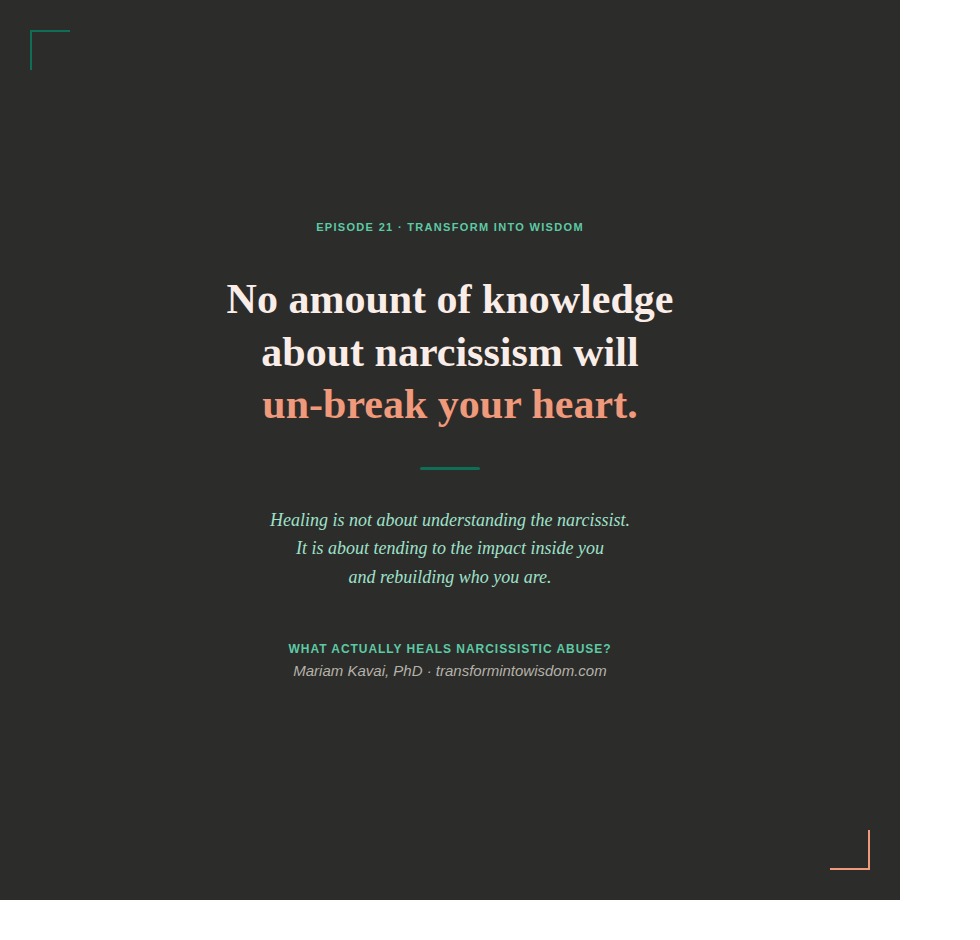
But here’s the truth: no amount of knowledge about narcissism will unbreak your heart.
You can map the deviant mind in detail all day long and still wake up with the same ache in your chest.
Because healing isn’t just about knowing. Healing asks something deeper. Something more human.
And that’s where our conversation begins today.
Healing After Narcissistic Abuse Is Like Being Hit by a Train That Never Stopped
Imagine this: you’re in a foreign country, wandering through the wilderness. Why? Because you love adventure. Going to a foreign country sounds like something that would spark your interest. You are not afraid to venture into the unknown, the road not taken.
What started out as a very exciting journey in a rugged but sturdy Toyota pickup truck, turned into what felt like the beginning of the story of Moses walking in the wilderness for 40 days and nights.
You’ve been walking for hours, maybe days, under the relentless sun.
And just when you think you can’t take another step, you stumble upon an underground opening.
It feels like a gift. A place to rest.
Inside, the air is cooler, and the lights shimmer strangely, almost invitingly. You lower yourself onto the stone platform, relieved and grateful to be out of the heat. For the first time in a long while, you feel a flicker of possibility — maybe this is a sign you’re nearing the end of your journey.
But what you don’t realize is that this place isn’t a refuge. It’s a crossing.
There are signs posted all around, but they’re written in a language you don’t understand. To you, it looks harmless, even safe. Just a platform to catch your breath.
Then the ground begins to tremble. Vibrations ripple beneath you. But your mind scrambles to explain it away. Where you come from, vibrations like these meant roadwork, maybe construction nearby. So you convince yourself: it must be happening somewhere out there.
Only it’s not.
Because there’s a train coming.
Its engine is faulty, so it doesn’t blow a horn. It doesn’t slow down. It doesn’t signal that it’s about to hit you.
It just barrels forward — full speed — and you don’t even realize you’re standing on the tracks… until it’s too late.
And when it hits, it shatters you.
Emotionally, psychologically, spiritually, and energetically — you are scattered across the debris of your own trust, instincts, and identity.
And the train? It doesn’t stop. It doesn’t reverse. It doesn’t even acknowledge the impact. It just keeps going — smooth, polished, intact.
A few people metres away thought they heard something, but when they look at the train they say: “Well, it doesn’t look like anything happened.”
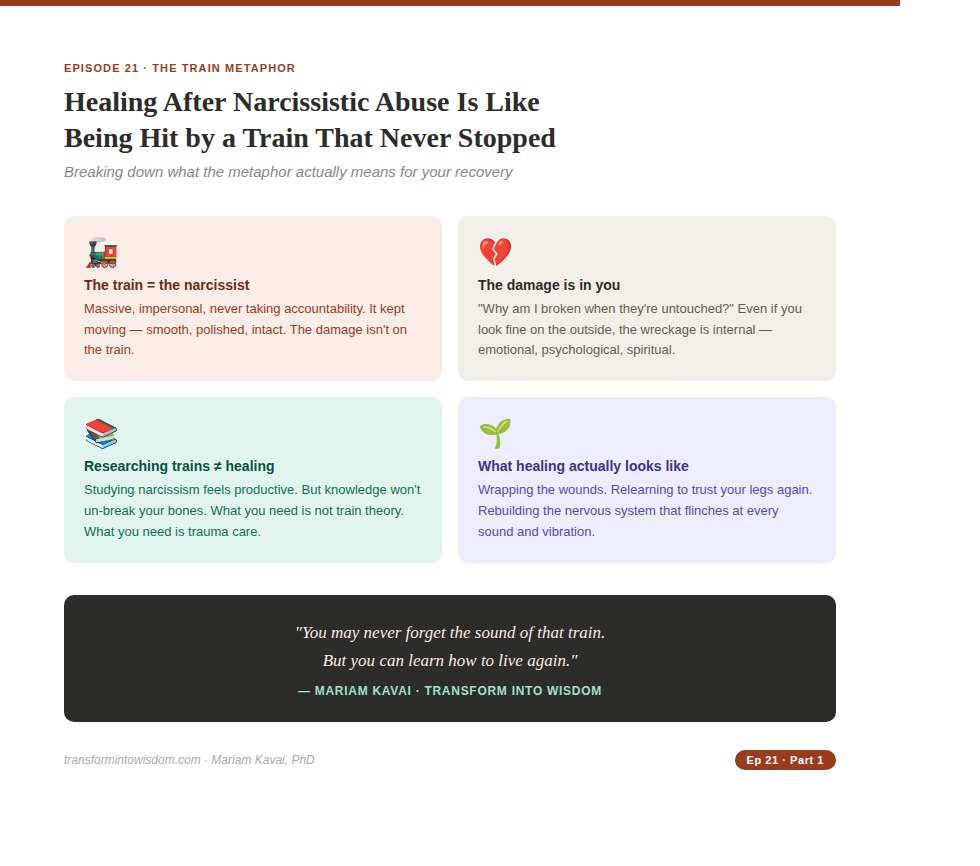
Because the damage isn’t on the train. The damage is in you.
And so you might start researching trains, trying to understand how they work: “Was it the tracks? Was I standing wrong? Did I miss a sign?”
You spend time understanding all the signs and what they mean, so that next time you are standing on the right side of the tracks and you understand the trains inside and out.
You imagine becoming a professor at the “National Train Institute“. And how you will teach train theory to others so that everyone is aware of the different trains and just how dangerous they are.
Sadly, this is the part that no one tells you.
Knowledge won’t un-break your bones.
No Amount of Knowledge About Narcissism Will Un-Break Your Heart.
What you need now isn’t train theory. But this is what so many people do. And it makes perfect sense that you would want to understand the scene of the crime: the train, where you were standing, the signs you missed. It’s perfectly understandable.
But the reality is that what you need is trauma care.
And in trauma care, most of the time they find an already existing wound that had a scab formed around it that was never addressed. And the doctor goes in and removes all the infected cells and tissues. And what you are left with is an open wound.
You need to wrap the wounds, relearn how to trust your legs again, trust yourself again, and rebuild the nervous system that flinches at every sound and vibration.
And here’s the truth no one tells you: you may never forget the sound of that train. But you can learn how to live again. Stronger, wiser, and with instincts sharp enough to never stand on those tracks again.
Let’s Break Down the Symbolism
The train symbolizes the narcissist: massive, impersonal, never taking accountability.
Your confusion is this: “Why am I broken when they’re untouched?” Even if you are physically well on the outside, you are broken on the inside.
Understanding the Abuse Isn’t the Same as Healing the Wound
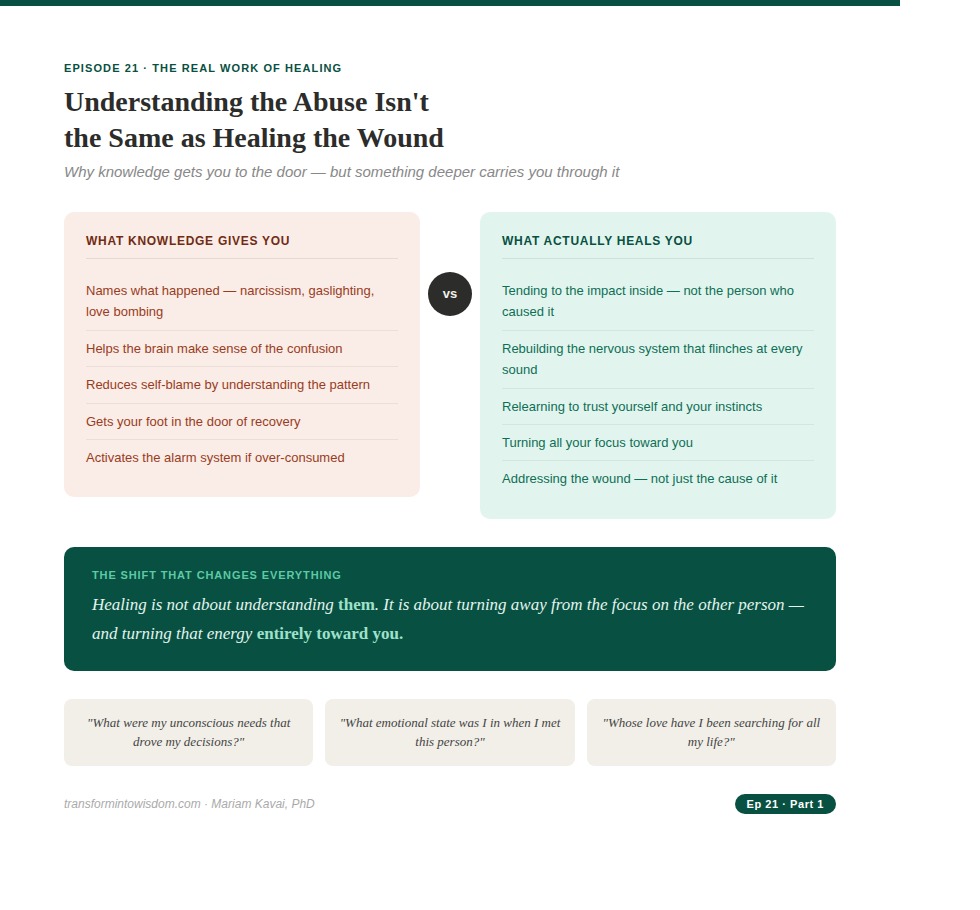
Knowledge is good because it gets our feet in the door — it helps us understand what happened and why it happened. Because the brain’s desire is to understand and to be understood. That’s human nature.
And you can spend years reading books, going to school, studying psychopathology. And that knowledge is not wasted — because we live primarily in a knowledge-based society. The more you know, the more likely people will listen to you.
But you can study and become an expert and still feel that something isn’t right. You flinch at every whistle, every vibration. You are triggered by loud noises and loud people. You wish you could crawl into a hole and never come out. You avoid people unless absolutely necessary. Your once vibrant social life is gone.
And you start to wonder — maybe there’s something you are missing. And that’s because there is.
No Amount of Knowledge About Narcissism Will Un-Break Your Heart.
Because healing is not about understanding the narcissist — it’s about tending to the impact inside you and rebuilding your identity. You suddenly realize that was not love. What is love? Did he ever love you? Was it all a lie?
You thought you could rely on yourself to move through the world, and yet the reality is showing you otherwise — that you loved the wrong person, you almost died, many parts of you died. How can you live in a world where you don’t even trust yourself and your judgment?
Imagine if you spend time trying to understand one type of narcissist, then you stumble upon Dr. Ramani’s work and you realize: there are many types of narcissists.
And so the spiral begins — I need to study all of them. It’s the only way I can be safe. I need to know how they work, how they think, all the signs to look for. What do their eyes look like when they’re lying? Should I study body language?
If you do this, you are activating all fire alarms, all security bells in your brain. Effectively, you are destroying your brain. You are in a war zone — according to your brain — except realistically you are in your home. Everything is filtered through the lens of “I am not safe.” And guess what happens? You don’t feel safe.
This is the part I want you to listen to keenly.
Healing Means Turning the Focus Back to You
Healing is not about understanding the narcissist — it’s about tending to the impact inside you and rebuilding your identity.
It’s about turning away from the focus on the other person who hurt you and turning that playbook on its head — and focusing only on you.
And that’s going to take some strong focus and determination. Because you were trained to focus on the other. In fact, it’s part of your personality traits.
And before you can get to healing, you have to address some very uncomfortable truths.
And the truth will set you free, but before it does, it will piss you off in a big way. And this part may hurt, so brace yourself.
What is it about you that made you vulnerable? When you met this person, what emotional state were you in? What were your unconscious needs that drove your decisions? Most of us were never seen or heard when we were kids. We were ignored — not just emotionally, but told we didn’t know anything.
We had to listen to the adults even when they claimed to love us and were hurting us instead. Most of us wanted attention, to be told we are loved and special by a parent. And because we didn’t get that, we went looking for love in all the wrong places.
Some people vehemently oppose this kind of introspection. They say things like: “Please don’t blame the victim. How dare you ask a question like that? I didn’t ask for this. This person did that to me, period.”
And what I hear from that is someone in a lot of pain. Someone who deserves justice. And I know that it’s probably 90% of narcissistic abuse victims who don’t get justice — unless someone dies, the abusers walk free among us.
Why Information Alone Can’t Repair What Trauma Broke
Most survivors struggle to understand something they never knew existed. It was something they never thought happened to good people. Maybe it happened to bad people. But not good people — with a good heart, who are kind, nurturing, generous, and forgiving.
“I was a good person; why did this happen to me?”
“I deeply cared for them; why did this happen to me?”
“I had treated them well; why did this happen to me?”
These questions may keep you up at night for a while — until you understand your family history, your shadow, and your vulnerabilities.
Until you understand your own shadow, your psyche, you will marry your father or your mother or your caretaker, and you will call it destiny.
Because that is familiar. Really simple. And the brain and nervous system like familiar.
And understanding this information is a puzzle piece that helps you calibrate and understand that you didn’t do this to yourself.
You didn’t do this to yourself.
And you can only heal when you turn all your focus on you. You can take them to court. You can win. They can be held accountable. And that may feel like justice. But that doesn’t change the fact that the damage is in you.
What happened to you was deeply unfair.
But if there is a chance that you want to live a normal life again, you have to shrink the rest of the world with their noise and focus on the most important person in your life. And that is you.
Just Because You Understand the Crazy Doesn’t Make You Whole Again
No Amount of Knowledge About Narcissism Will Un-Break Your Heart. Let me take it even further: no amount of knowledge about narcissism will heal your nervous system.
No Amount of Knowledge About Narcissism Will Heal Your Nervous System.
Ep 21 – Transform into Wisdom Podcast
Just because you understand the crazy doesn’t make you whole again.
If you find this show helpful, please consider leaving a review on Apple Podcasts, Spotify, or wherever you listen.
I want to stop there for today and give you time to let that percolate and sink in. We will continue this conversation in Part 2.