
Have you ever wondered why you are still carrying this wound long after others seem to have moved on? A client said something to me recently that stopped me completely.
She said “I had no idea how much weight I have been carrying all these years. And I can’t believe the pain — which is still there — that is so old. I can’t believe how deep this wound has gone.”
And I sat with her in silence.
Because some things deserve a moment of silence before anything else is offered.
That is why I made this episode. Find somewhere quiet. Let’s find out together.
The 7 Dimensions of Trauma That Explain the Depth of Your Pain
What my client described — that old pain, that depth of wound she couldn’t quite believe was still there — is exactly what this episode is about. We are going to begin somewhere broader — with pain and suffering in general — and then move to the context of sensitive souls specifically.
And then in the next few episodes, we will come full circle to sensitive souls in narcissistic relationships and why narcissistic abuse hurts so much.
You’ll see how this all makes sense. And perhaps for the first time, you will stop blaming yourself for someone else’s pathology or trauma. Meaning — you were harmed by someone else’s lack of conscience, or in some cases their lack of awareness, or their lack of emotional maturity.
I want to give you a framework today. Seven dimensions of a traumatic experience that determine, in large part, how deeply it wounds the person living through it.
Not one of these dimensions alone tells the full story.
But when you hold all seven together and look at your own history through that lens — I think something will shift for you. Not because the pain will disappear. But because you will finally understand why it was always this deep.
Let’s go through them.
DIMENSION ONE — WHAT
What the Traumatic Event Actually Was
Picture 2 friends from your neighborhood. You grew up with them. They live in neighboring cities not too far away. It’s thanksgiving weekend, they travel back in town to see their families, you are excited to see them.
And they call you separately and say that as they were driving home to be with their families for the thanksgiving holiday, the roads were so bad from the snow the night before that both of them were involved in accidents on the same stretch of highway.
Both walked away physically unharmed. Both are shaken — deeply shaken — for days afterward.
Now imagine it is you. Not them. You.
You have never been in a car accident. But for twelve years, you lived inside a marriage where the person who was supposed to love you used your most private vulnerabilities against you with surgical precision. Where you never knew which version of Tuesday you were going to get.
Where love was something you had to earn, and then earn again, and then wonder why it still wasn’t enough. Where you were told more times than you can count that what you were experiencing wasn’t real. That you were the problem.
All 3 of you have experienced something distressing. But you have not experienced the same thing. And the research confirms what your body already knows.
A large meta-analysis published in the British Journal of Psychiatry examined PTSD rates across thousands of trauma-exposed children and adolescents.
It showed that boys exposed to impersonal trauma — accidents, natural disasters, events where no one intended them harm — showed a PTSD rate of around eight percent. Girls exposed to interpersonal trauma — harm caused deliberately by another human being — showed a rate of almost thirty-three percent.
The same word, trauma, concealing a fourfold difference in impact.
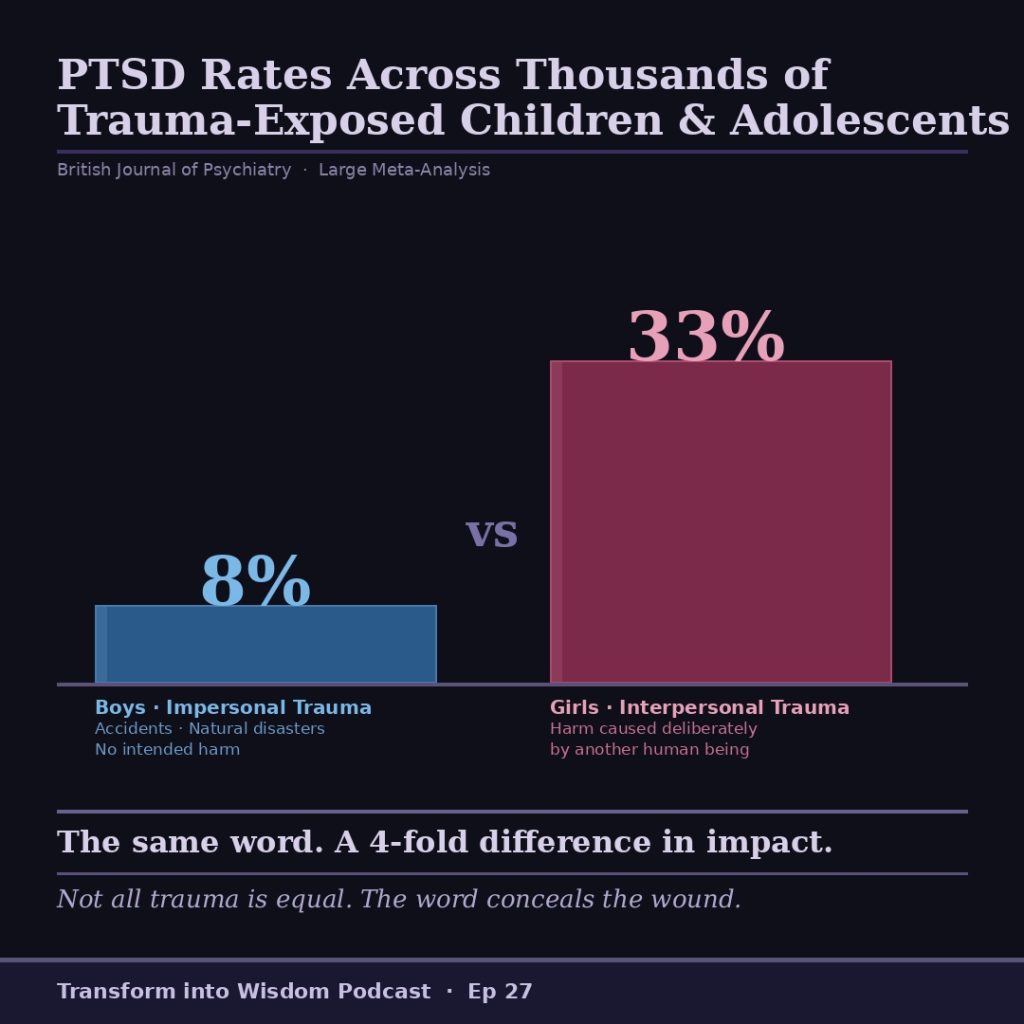
What happened to you is not just a category. It is a variable.
And interpersonal, intentional harm — harm through a relationship — is in the highest damage category the research identifies.
This is not a subjective assessment. This is a measurable, replicable scientific finding.
Your two friends will likely recover from their accidents. You are carrying something in a different category entirely. And it was never a fair comparison to begin with.
DIMENSION TWO — FOR HOW LONG
The Duration and Chronicity of the Exposure to Trauma
Now stay with your own story for a moment. Because it didn’t happen once. It happened every day. For years.
Trauma research done by Judith Herman — a psychiatrist at Harvard Medical School identified that the symptoms produced by prolonged, repeated trauma were qualitatively different from the symptoms produced by a single traumatic incident.
She named this complex PTSD.
Here is the simplest way I can explain the difference. Classic PTSD is what happens to your sense of safety. Complex PTSD is what happens to your sense of self.
Think of it this way. A single powerful storm can damage a house — shatter a window, tear away part of the roof. The damage is real and it needs repair. But the structure of the house is still recognizable. You can see what it was, and what it needs to become whole again.
Now imagine not one storm, but years of weather. Cold that gets into the walls. Dampness that slowly undermines the foundation. Pressure that shifts the frame so gradually that no single day looks like a crisis — until one morning you look at the house, and you cannot remember what it was supposed to look like from the inside.
That is what prolonged trauma does to you. Not one devastating event that leaves a clear wound. A slow, cumulative erosion of the person you were. Of your ability to trust your own perceptions. Of your sense that you are someone worthy of being treated well.
And if you are sitting with the question of why you can’t simply move on — why what happened years ago still lives so close to the surface — the ACE Study gives you part of the answer.
The Adverse Childhood Experiences Study, one of the largest public health investigations ever conducted, demonstrated a dose-response relationship replicated in more than thirty thousand subsequent studies.
As the number of adverse experiences rises, the risk of depression, anxiety, and physical illness rises with it. Not linearly. Cumulatively. Each layer adds weight that your nervous system carries forward into every room of your adult life.
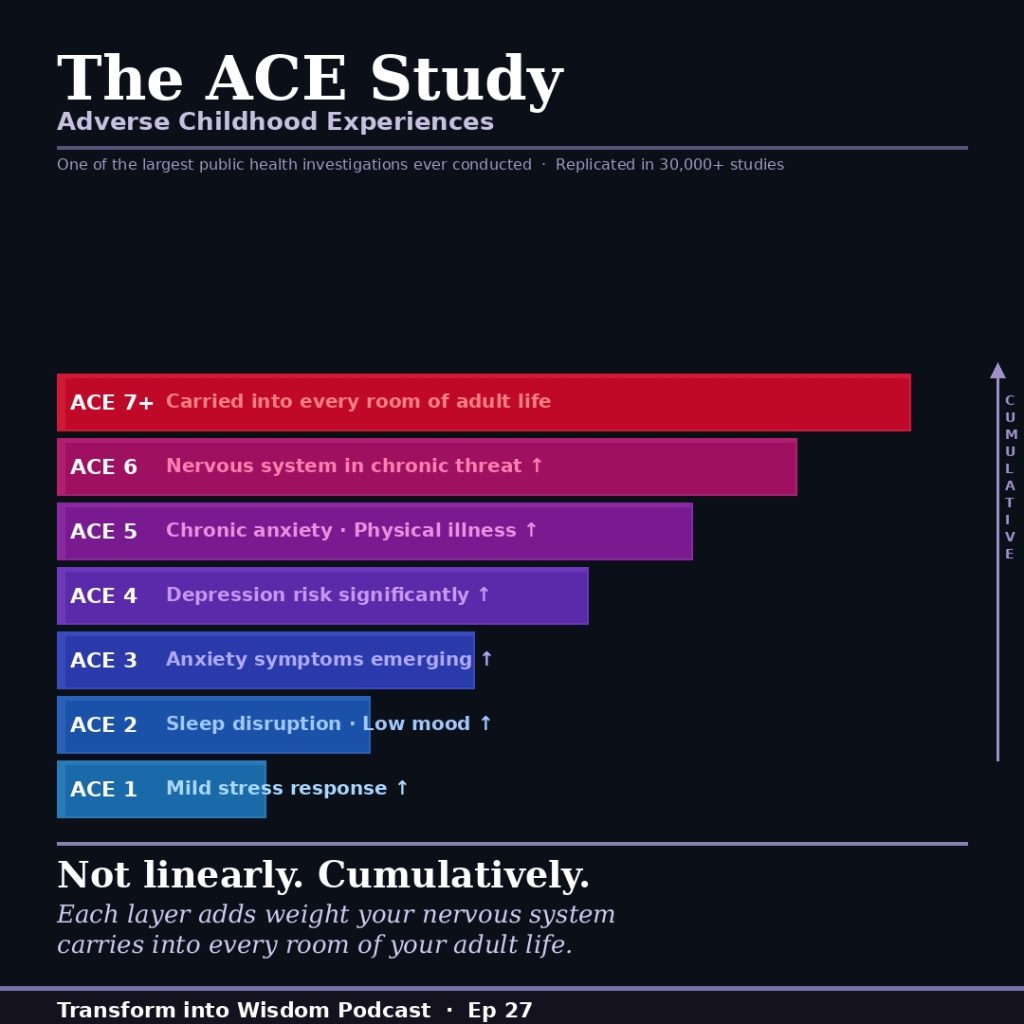
Duration is not a detail. It is a defining variable. And the longer you were inside it, the more your nervous system had to reorganize itself around surviving it.
And that’s why the impact of child abuse or childhood trauma—be it adoption, living in foster care, or living with a narcissistic parent or emotionally unavailable parent are so pervasive and so significant because they happened for a long time. 18 years is a long time.
It’s like having an 18 year-sentence and then another number of years surviving the effects of the harm before the chickens come home to roost and you are confronted by the trauma that you’ve tried so hard to burry. “Trauma keeps the score” as they say or more accurately, “the body keeps the score”.
And if the damage was done for 18 years, please be patient as you dismantle the maze that is the old software, the virus of childhood trauma and then rebuilding using a new software of your choosing. Playing by your own rules rather than someone else’s rules.
DIMENSION THREE — WITH WHOM
Personal versus Impersonal: The Specific Wound of Betrayal Trauma
Go back to your two friends for a moment. Imagine that one of them discovers, weeks after her accident, that the other driver was a stranger who simply lost control on a wet road.
And now imagine the other discovers something different — that the driver who hit her was someone she knew. Someone who had been stalking her and followed her deliberately and hit her but somehow she escaped unharmed.
Same accident. Same physical outcome. Incomparably different wound.
Because the source of the harm is not a neutral variable. It is perhaps the most significant variable of all.
And now bring it back to you. The person who hurt you was not a stranger. Maybe it was a parent. Or they were someone you loved.
Someone you built a life with, or grew up besides, or trusted with the parts of yourself you had never shown anyone else. And that — that specific fact — is what puts what happened to you in a category that a car accident, however frightening, will never occupy.
Jennifer Joy Freyd, a psychologist at the University of Oregon, developed Betrayal Trauma Theory. Her central insight is this: when the source of harm is someone you depend upon — for survival, for safety, for your sense of reality — your nervous system cannot process it the way it processes a threat from a stranger.
Because to fully register the betrayal is to fully register that your source of safety is simultaneously your source of danger. And for a child, or for someone in a relationship of deep emotional dependency, that recognition is not survivable in the conscious mind.
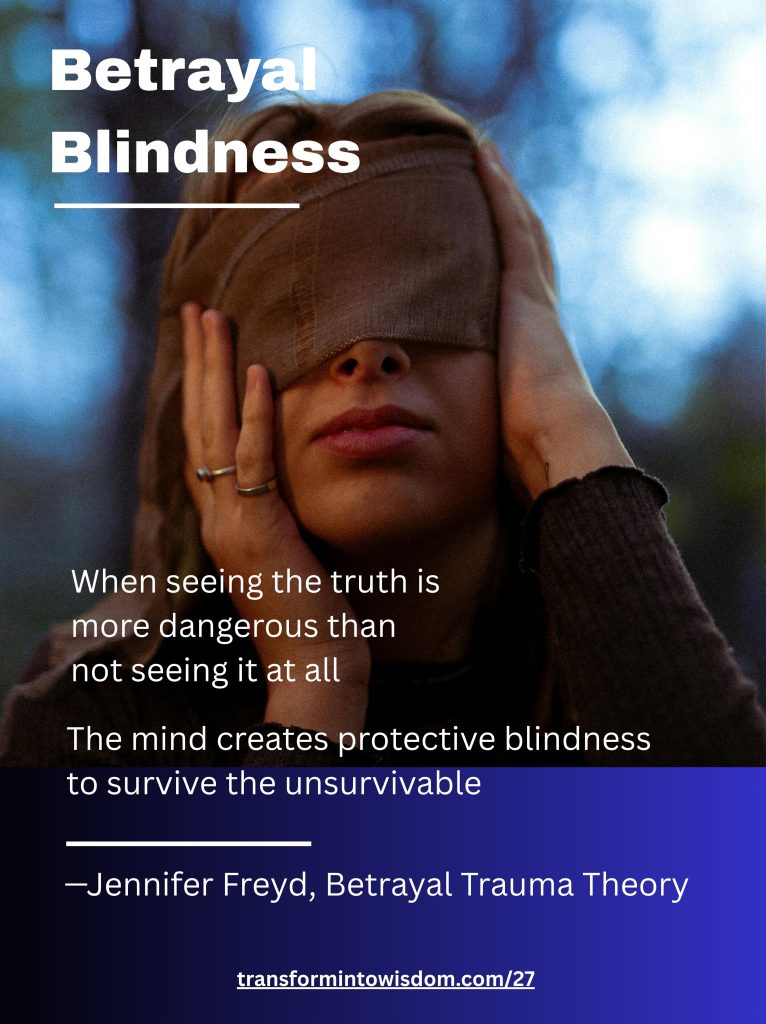
Betrayal Blindness
So, your mind does what it must. It finds ways not to fully know. It creates what Freyd calls betrayal blindness — “a protective not-seeing” that allows the relationship, and therefore your survival, to continue. You kept loving the person who was harming you. Not because you were naive.
Not because you were weak. Because your nervous system made an unconscious calculation: knowing this fully is more dangerous than not knowing it.
Studies using Freyd’s own measurement tools found consistently that high-betrayal traumas predicted dissociation, anxiety, depression, and physical health problems in ways that low-betrayal traumas simply did not. The betrayal is the variable. Not just the event.
And then there is the person who didn’t stop it.
The Enabler
I want you to think about whether there was someone in your life who knew — or who could have known — and who chose not to intervene. Not always with malice.
Sometimes simply because their own comfort, their own version of the story, their own needs mattered more to them in that moment than the reality of what was happening to you.
Research going back to Everson and colleagues in 1989 found that the response of the non-offending caregiver following disclosure of abuse was one of the strongest predictors of a child’s psychological outcome — in some cases a stronger predictor than the characteristics of the abuse itself. Not the severity.
Not the duration. But whether the person who was supposed to protect you stood between you and the harm.
When they did not — when they minimized, or looked away, or kept the peace at your expense — that was not a passive failure. That was an active abandonment. And it produced its own wound, entirely separate from and compounding the original harm.
DARVO: Deny, Attack, Reverse Victim & Offender
And Freyd named what happens when the person who caused the harm is confronted. She called it DARVO.
DARVO: Deny the behavior. Attack the credibility of the person who named it. Reverse Victim and Offender — reframe themselves as the true victim, the misunderstood one, the one being treated unjustly.
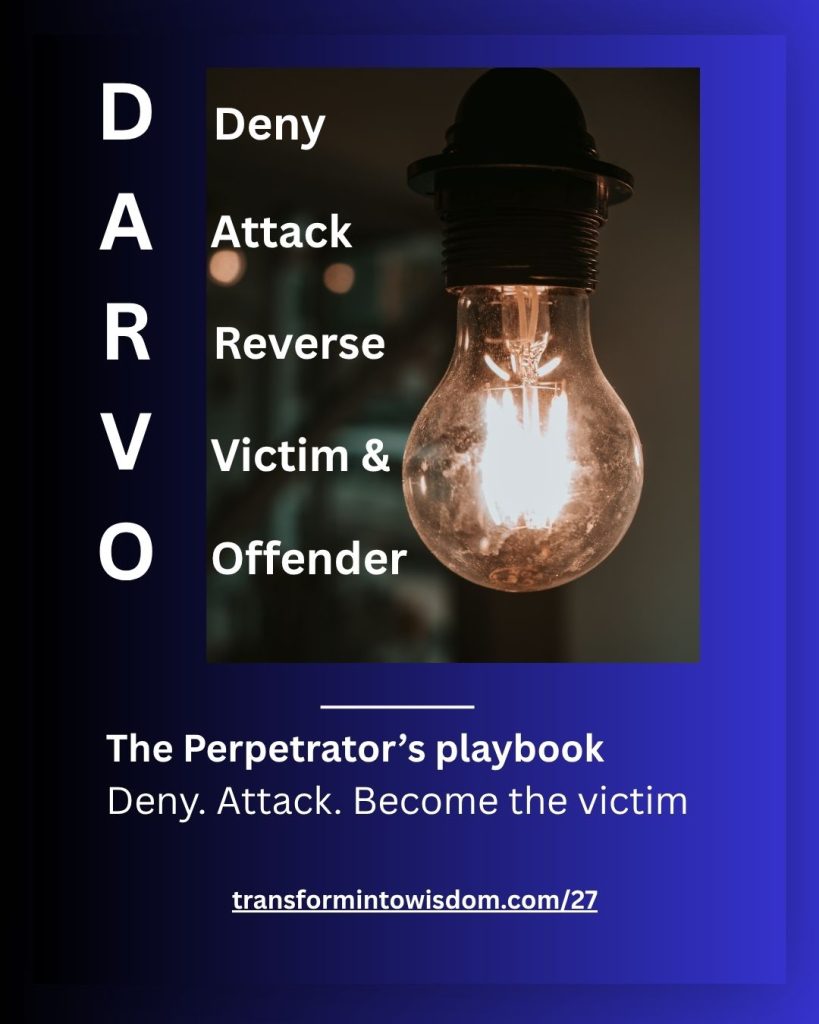
Research shows that exposure to DARVO increases the victim’s self-blame. It shifts observers’ perceptions toward the perpetrator and away from the person telling the truth.
And if you grew up watching this sequence — if you told the truth and were told you were the problem, if you named the harm and were made to feel that naming it was the real offense — you are carrying not just the original wound, but the specific disorientation of having your reality dismantled by two people at once.
That is not confusion. That is the logical result of being gaslit by the person who hurt you and the person who refused to see it.
DIMENSION FOUR — WHERE
The Location and Context of the Harm
Where trauma happens shapes the nature of the wound in ways that are not always obvious. And I want you to think about where yours happened — because it matters more than you might realize.
Consider a teenage girl who is humiliated by a teacher in front of her entire class. The shame is public. Everyone witnesses it. And then — because we live in the digital age — someone records it, and it circulates.
The wound is no longer contained to that classroom. It follows her into every space she enters, because the people in those spaces have already seen it before she walks through the door.
Now consider you. Perhaps the harm in your life happened at home. Behind closed doors. In rooms that no one else ever entered.
It was invisible to the outside world — so invisible, in fact, that on Monday morning you walked into work, or school and everyone around you saw someone who appeared completely fine. Because the place where the harm happened was also the place where no one was looking.
Public harm — humiliation in school, workplace abuse, reputational destruction, the calculated public shaming we see documented in cases that make it onto our screens — carries the wound of exposure.
The world becomes the witness to your worst moment. There is a particular violence in having your pain on display without your consent.
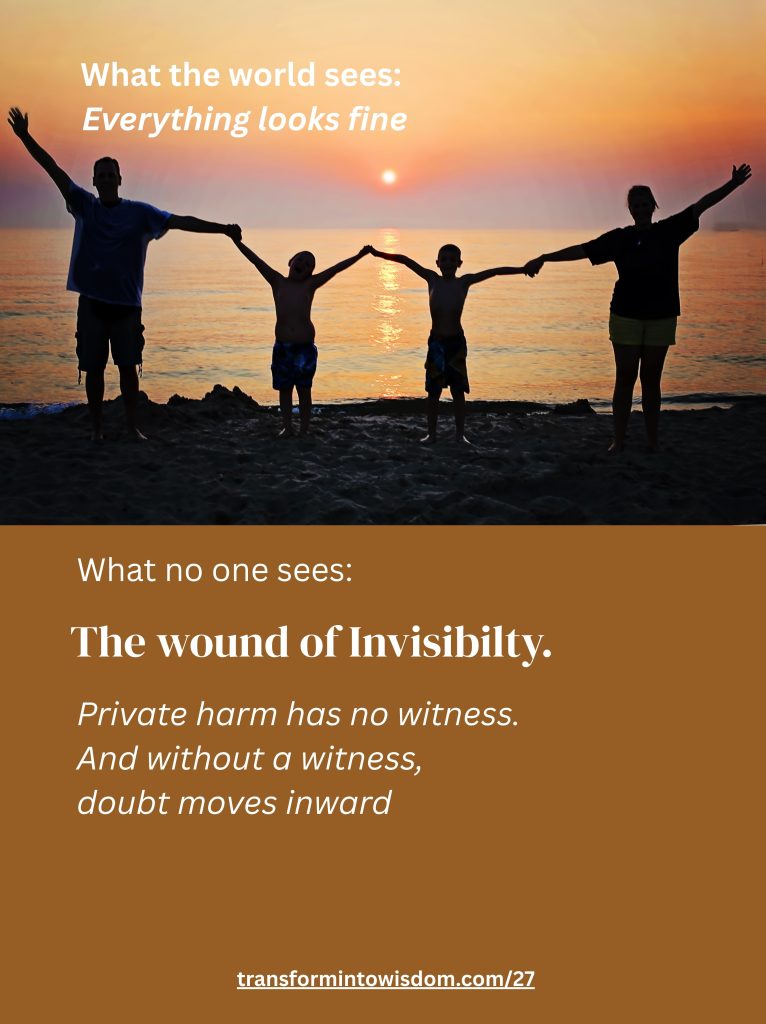
The wound of invisibility.
But private harm carries something different. The wound of invisibility.
The wound of having to return, again and again, to the place where the harm lives — the home, the bedroom, the marriage, the family dinner table — while the rest of the world sees nothing wrong. Of being the only person in the room who knows what that room actually is.
Private harm can go unnamed for years. Sometimes decades. Sometimes a lifetime. And that invisibility — the absence of any external witness to confirm that what you experienced was real — is its own specific cruelty.
Because without a witness, the doubt moves inward. And you become the one who questions whether it was really as bad as it felt.
It was. The location just made it easier for everyone else not to see.
DIMENSION FIVE — WHEN
Where You Were in Your Development When it Happened
There is a reason that what happens to us in childhood does not leave us the way an adult experience does.
The developing brain has what researchers call sensitive periods — windows of time when the architecture of your nervous system is being built.
The structures that will govern your emotions, your memory, your threat response, and your capacity for attachment for the rest of your life are being laid down during these years. And when chronic stress and trauma arrive during these windows, they do not simply hurt the child. They alter the build.
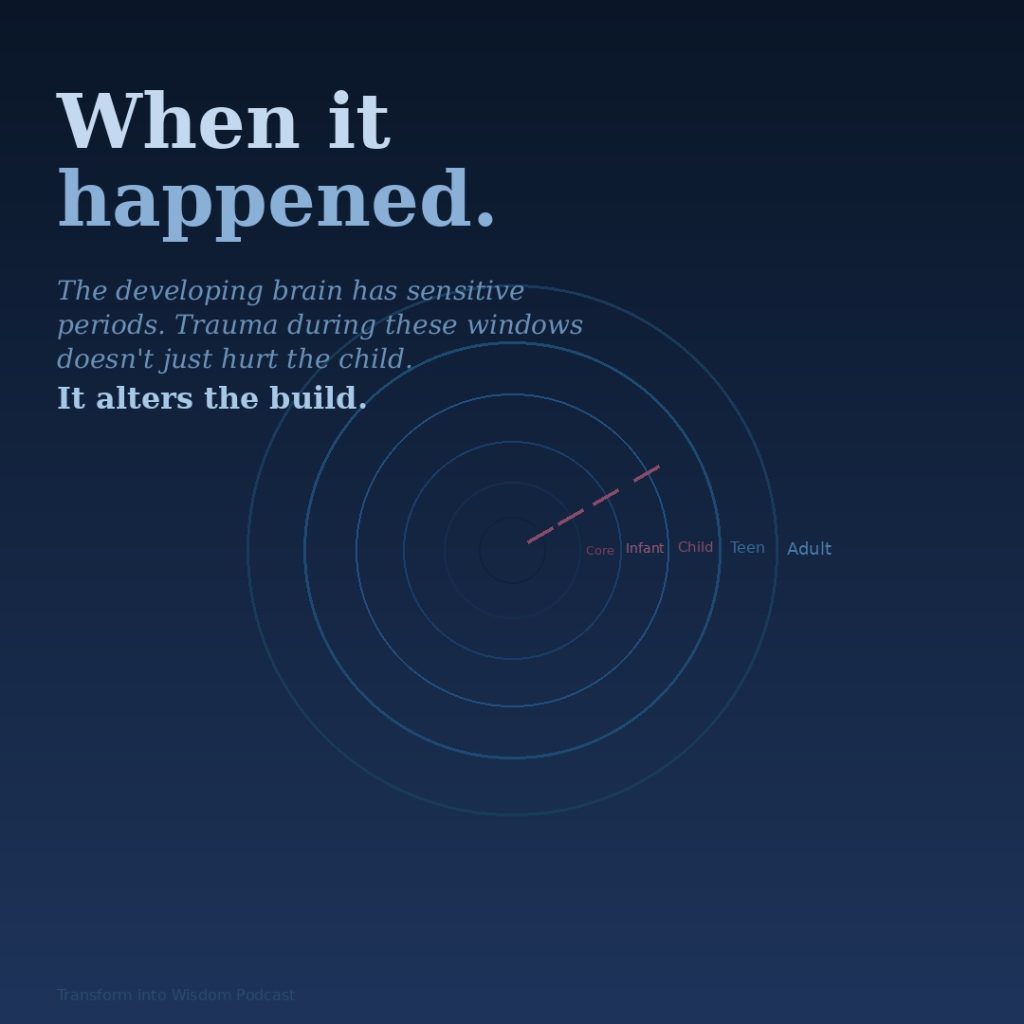
Imagine constructing a building during a period of severe structural interference. The materials are compromised while the foundation is being poured. The frame goes in slightly off-true.
The building is finished — it stands, it functions — but certain walls will always be slightly uneven. Certain doors will never quite close properly. Not because of anything the building did. Because of what was present in the environment during construction.
If what happened to you began in childhood — if the harm arrived before you had language for it, before you had memory that could hold it, before you had any adult capacity to understand what was being done to you — then your nervous system was not just hurt.
It was built around the hurt. Optimized for threat, because threat was the environment in which it developed. Extraordinarily efficient at detecting danger, scanning for warning signs, preparing your body to respond — because that was what it needed to do to survive.
And then that same nervous system arrived in your adult life. In relationships and environments that may, finally, be safe. And it continues to do what it was built to do. It finds threat where there may be none.
It responds to ordinary tension as though it is the beginning of something catastrophic. Not because you are irrational. Because the architecture was laid down before you had the capacity to choose it — and long before you had any way to know it was happening.
This is why childhood trauma is not simply an earlier version of adult trauma. It is a different category of experience. Because it happened while the very instrument you would later need for recovery was still being formed.
Let’s pause here for now to allow you to reflect and we will continue in the next episode.
Until then — stay empowered and true to yourself.
~ Mariam
References
DIMENSION ONE — What
Alisic, E., Zalta, A. K., Van Wesel, F., Larsen, S. E., Hafstad, G. S., Hassanpour, K., & Smid, G. E. (2014). Rates of post-traumatic stress disorder in trauma-exposed children and adolescents: Meta-analysis. British Journal of Psychiatry, 204(5), 335–340.
DIMENSION TWO — For How Long
Herman, J. L. (1992). Trauma and Recovery: The Aftermath of Violence — From Domestic Abuse to Political Terror.Basic Books.
Herman, J. L. (1992). Complex PTSD: A syndrome in survivors of prolonged and repeated trauma. Journal of Traumatic Stress, 5(3), 377–391.
Felitti, V. J., Anda, R. F., Nordenberg, D., Williamson, D. F., Spitz, A. M., Edwards, V., Koss, M. P., & Marks, J. S. (1998). Relationship of childhood abuse and household dysfunction to many of the leading causes of death in adults: The Adverse Childhood Experiences (ACE) Study. American Journal of Preventive Medicine, 14(4), 245–258.
Cloitre, M., Garvert, D. W., Brewin, C. R., Bryant, R. A., & Maercker, A. (2013). Evidence for proposed ICD-11 PTSD and complex PTSD: A latent profile approach. European Journal of Psychotraumatology, 4(1), 20706.
DIMENSION THREE — With Whom
Freyd, J. J. (1996). Betrayal Trauma: The Logic of Forgetting Childhood Abuse. Harvard University Press.
Freyd, J. J. (1994). Betrayal trauma: Traumatic amnesia as an adaptive response to childhood abuse. Ethics & Behavior, 4(4), 307–329.
Freyd, J. J. (1997). Violations of power, adaptive blindness, and betrayal trauma theory. Feminism & Psychology, 7(1), 22–32.
Freyd, J. J., Klest, B., & Allard, C. B. (2005). Betrayal trauma: Relationship to physical health, psychological distress, and a written disclosure intervention. Journal of Trauma & Dissociation, 6(3), 83–104.
Goldsmith, R. E., Freyd, J. J., & DePrince, A. P. (2012). Betrayal trauma: Associations with psychological and physical symptoms in young adults. Journal of Interpersonal Violence, 27(3), 547–567.
Martin, C. G., Cromer, L. D., DePrince, A. P., & Freyd, J. J. (2013). The role of cumulative trauma, betrayal, and appraisals in understanding trauma symptomatology. Psychological Trauma: Theory, Research, Practice, and Policy, 5(2), 110–118.
Harsey, S. J., Zurbriggen, E. L., & Freyd, J. J. (2017). Perpetrator responses to victim confrontation: DARVO and victim self-blame. Journal of Aggression, Maltreatment & Trauma, 26(6), 644–663.
Harsey, S. J., & Freyd, J. J. (2020). Deny, attack, and reverse victim and offender (DARVO): What is the influence on perceived perpetrator and victim credibility? Journal of Aggression, Maltreatment & Trauma, 29(8), 897–916.
Everson, M. D., Hunter, W. M., Runyan, D. K., Edelsohn, G. A., & Coulter, M. L. (1989). Maternal support following disclosure of incest. American Journal of Orthopsychiatry, 59(2), 197–207.
Smith, C. P., & Freyd, J. J. (2013). Dangerous safe havens: Institutional betrayal exacerbates sexual trauma. Journal of Traumatic Stress, 26(1), 119–124.
Smith, C. P., & Freyd, J. J. (2014). Institutional betrayal. American Psychologist, 69(6), 575–587.
DIMENSION FOUR — Where
Maercker, A., & Horn, A. B. (2013). A socio-interpersonal perspective on PTSD: The case for environments and interpersonal processes. Clinical Psychology & Psychotherapy, 20(6), 465–481.
Bryant-Davis, T. (2019). The cultural context of trauma recovery: Considering the posttraumatic stress disorder practice guideline and intersectionality. Psychotherapy, 56(3), 400–408.
DIMENSION FIVE — When
Opendak, M., & Sullivan, R. M. (2016). Unique neurobiology during the sensitive period for attachment produces distinctive infant trauma processing. European Journal of Psychotraumatology, 7(1), 31758.
Van der Kolk, B. A. (2005). Developmental trauma disorder: Toward a rational diagnosis for children with complex trauma histories. Psychiatric Annals, 35(5), 401–408.
Maercker, A., & Horn, A. B. (2013). A socio-interpersonal perspective on PTSD: The case for environments and interpersonal processes. Clinical Psychology & Psychotherapy, 20(6), 465–481.