
Today, we’re continuing our deep dive into what daughters of narcissistic fathers need to know—this is Part 4 of the series.
Why does this matter so much?
Because if you’ve found yourself in narcissistic relationships later in life… it didn’t just start there.
It started somewhere much earlier.
Somewhere closer to home.
And in many cases, it started with him—your father.
And that means… it didn’t start with you.
You are not the source of your wounding.
You didn’t break yourself.
This didn’t come out of nowhere.
By gently tracing back to the beginning—by examining what happened and also what didn’t happen—you begin to reconnect with what’s true.
You begin to see your story clearly.
And from that place of clarity, you begin to heal.
So, let’s go deeper into the fourth layer of harm—what I call the active and passive harm from a narcissistic father.
Part 4: The Active & Passive Harm from a Narcissistic Father
5. Verbal abuse (which includes things like intimidation, coercion, berating and belittling, name-calling, and blame-shifting)
| Type of Verbal Abuse | Examples | Impact on YOU |
| Criticism and Berating | “You’ll never be good enough.” “What’s wrong with you?” | Internalized shame, questioning your worth, perfectionism |
| Belittling and Dismissiveness | “You’re too sensitive.” “Stop being dramatic.” | Emotional invalidation, self-doubt, repression of feelings |
| Gaslighting | “That never happened.” “You’re imagining things.” | Confusion, loss of trust in your own memory and perception |
| Name-calling and Mockery | “You’re pathetic.” “You’re just like your crazy mother.” | Deep identity wounds, negative self-image, toxic inner dialogue |
| Shaming and Guilt-tripping | “After all I’ve done for you…” “You’re an ungrateful daughter.” | Chronic guilt, fear of asserting needs, difficulty setting boundaries |
| Withholding Praise or Approval | Silent treatment after accomplishments No acknowledgment of effort | Insecurity, hunger for external validation, people-pleasing |
| Threats and Intimidation | “You’ll regret that.” “You better watch yourself.” | Hypervigilance, anxiety, fear of consequences for authentic self-expression |
| Blame-shifting and Projection | “It’s your fault I’m angry.” “You made me act this way.” | Self-blame, inability to discern responsibility, toxic loyalty |
| Controlling Language | “You can’t do that.” “I know what’s best for you.” | Loss of autonomy, dependence on others to make decisions |
| Invalidation of Emotions or Needs | “Stop crying, or I’ll give you something to cry about.” | Repression, emotional numbness, difficulty trusting her own emotions |
Let’s talk about verbal abuse.
I’m not going to list every form of it here—because if you’ve lived it, you already know.
Maybe it came as direct insults…
Or subtle jabs disguised as “jokes.”
Maybe it was sarcasm that cut deep…
Or constant belittling that made you feel small.
Maybe it was shouting.
Maybe it was silence used as punishment.
Whatever form it took, here’s what matters:
Verbal Abuse Shapes Your Inner World.
It leaves behind an internal residue—a kind of emotional static—that distorts how you hear yourself.
You begin to doubt your value.
You question your perceptions.
You minimize your needs.
You anticipate being misunderstood or rejected, even before you speak.
Over time, you may internalize that abuse.
You start talking to yourself the way they talked to you.
Not because it’s true—but because repetition became belief.
And belief became identity.
And your identity became your reality.
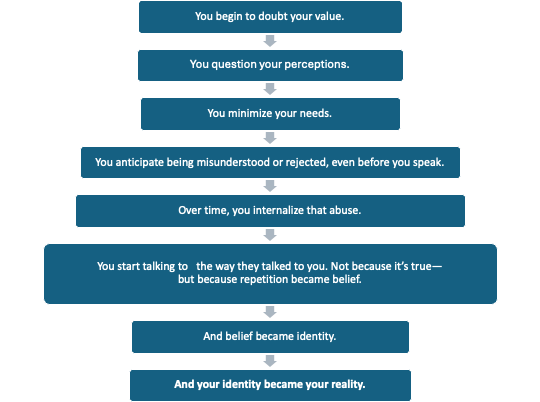
That’s how verbal abuse breaks a person down—not just in the moment it’s happening, but in the ongoing echo it creates inside your psyche.
Integration of Trauma as Part of the Healing Process
But here’s the part I want to offer you hope around: Integration is possible
And it begins not with silencing that internal voice,
but with recognizing—this voice is not you.
It was formed in a specific environment…
By someone who couldn’t or wouldn’t love you well.
Someone who used words as weapons, not as bridges.
So, your healing isn’t about “thinking positive” or pretending the words didn’t hurt.
It’s about reclaiming your inner space.
It’s about learning to speak to yourself with truth and tenderness.
To rebuild trust with your own voice.
To say things you never heard growing up:
- “I believe you.”
- “You make sense.”
- “You didn’t deserve that.”
- “You’re allowed to take up space.”
Verbal abuse distorts your reality.
But healing helps you restore it.
Slowly, gently, through conscious awareness and compassionate truth-telling.
Your voice isn’t broken.
It’s waiting to be remembered.
And your truth isn’t too much.
It’s the map back to yourself.
A Gentle Reflection
So, I invite you to reflect on this:
What messages have you been repeating to yourself that didn’t originate from you?
Take a moment.
Whose voice lives in your inner dialogue?
And what would it feel like to speak to yourself in a tone rooted in truth, not trauma?
Episode Recap—Unpacking the Impact of Active and Passive Harm from a Narcissistic Father.
As we close this episode, I want to gently bring us back to the deeper intention
behind this entire series starting from Episode 9, where we began
unpacking “The Impact of Active and Passive Harm from a Narcissistic Father.”
Here’s a brief recap of the emotional patterns we’ve explored: What is the long-term impact of a narcissistic father?
The Invisible Scars of Growing Up with a Narcissistic Father
1. A deep-rooted sense of unsafety and self- doubt.
Because the one who was meant to protect you was often the source of harm.
You learned to live in a state of hypervigilance, never feeling quite safe in your body or your world.
2. Taking on a role that wasn’t yours.
Maybe the fixer, the invisible one, the golden child, or the scapegoat.
You molded yourself to survive, not to thrive
3. You have a broken radar.
You don’t always notice when something is harmful, or you override your intuition.
You say yes when you mean no… You stay when you should go. It’s like walking through life with a faulty compass.
4. A deep attachment wound.
Your earliest model of love was inconsistent or unsafe, so connection often feels like longing rather than nourishment.
5. A hunger for relationships—friendships, partnerships, any kind of emotional bond
Because you’re still trying to feed an unmet need from childhood.
6. Attracting emotionally unavailable people
Not because you want pain, but because your nervous system recognizes it.
You bond through survival patterns, not through true compatibility.
7. Difficulty letting go of toxic dynamics
Because love and pain became fused in your psyche.
Somewhere deep inside, suffering started to feel like proof of love.
8. Guilt and shame
Not just about what happened, but for even naming it.
You were conditioned to protect your father’s image, even at the cost of your own reality.
9. Emotional suppression
Because you watched him avoid vulnerability, and so you learned to silence your own feelings.
You became emotionally dysregulated, not because something’s wrong with you,
but because you never learned another way.
10. Disconnection from your own needs and desires
You were trained to tune in to others while tuning out yourself.
Even now, it may feel easier to care for others than to name what you want.
11. Perfectionism and over-functioning
If you are not careful, it can be a way to feel worthy, needed, and in control.
But it can quietly burn you out when your inner child is still trying to earn love.
12. Self-blame and chronic self-criticism
When something goes wrong, your first instinct is to turn inward.
You carry the burden, even when it’s not yours to carry.
13. Shame around vulnerability
Especially around expressing sadness or asking for help.
These parts of you were never mirrored or validated, so they now feel foreign or even weak.
There’s still one more deeply damaging narcissistic dynamic that I believe deserves an entire episode of its own, and that’s what I’ll cover next, before we begin exploring what daughters of narcissistic fathers didn’t get.
But for now, I want to leave you with something larger than a list.
What Can We Learn from All of This?
The role of a father shapes the foundation of a child’s emotional world.
It imprints not only how she sees herself, but also how she navigates love, worthiness, and connection.
A narcissistic father—much like anyone with narcissistic traits—lives in a distorted version of reality.
And when you grow up inside that reality, it can take years to realize it was never yours to begin with.
Healing begins when you start to reclaim what you know to be true.
The impact of a narcissistic father doesn’t just happen in moments of harm—it happens in what follows:
- The silence.
- The rationalizing.
- The normalization of violence and control.
- The way love gets entangled with pain.
- The shame that says, “Maybe I deserved this.”
- The guilt that keeps you quiet.
- The confusion that keeps you stuck.
This is how generational harm is passed down—not just through behavior, but through the beliefs we inherit when we’re too young to challenge them.
But here’s the truth:
- You are not your past.
- You are not your father.
- You are not the story he tried to write for you.
You can change the blueprint.
You can leave the role of survival behind.
Your feelings—the ones you were taught to suppress—are not too much.
They are messengers.
They are the key to your healing.
So, I’ll leave you with this final question:
What will you do with the meaning of what you’ve lived through?
Will you let it define you through pain?
Or will you be brave enough to feel it, name it, and transform it into power?
The choice is yours.
And you’re not alone.