Ep 23 — Why Your Body Won’t Let You Heal: Narcissistic Abuse, Trauma & Your Nervous System
You’re out. You’ve moved to a new apartment. Maybe you’ve moved to a new city. You’ve done the research. You understand what happened. You’ve finally put a name to the chaos: Narcissistic abuse. You’ve told yourself it’s over. Case closed, right? You should be moving on. You should be sleeping through the night.
So why does your body still act like there’s a killer in your house?
Why do you still “freeze” in the grocery aisle because you smelled a certain cologne? Why does your stomach drop into a pit because a garage door opened?
Why do you find yourself apologizing for things you didn’t do, or “fawning” over people you don’t even like, just to keep the peace? Why, even in total silence, is your body still vibrating like it’s waiting for a grenade to go off?
You tell yourself you’re safe. You say it like a mantra. But your pulse is calling you a liar.
Here’s the reality. You aren’t failing at recovery. Your nervous system is simply still standing guard at a post it was never taught to leave. And here is the truth they don’t tell you: You cannot think your way out of a physiological state.
Healing is not a mental puzzle.
And until you understand what narcissistic abuse did to your central nervous system, you will keep trying to heal from the neck up — when the real work is happening in the body. Because until you settle the debt with your nerves, you’re not actually free. You’re just a fugitive in your own skin.
Today, we go below the logic. We’re talking about the biology of betrayal, and why the path to true freedom isn’t a thought — it’s a felt sense.
Hello beautiful tribe! How are you? I hope you are well and keeping yourself safe and grounded in these interesting times!
In this episode, we go deep into the science and biology of why narcissistic abuse creates such profound, lasting damage — not just emotionally, but neurologically.
As a PhD researcher and someone who has walked this path, I want you to understand what’s actually happening in your brain and body — because that understanding is not just intellectually fascinating. It is liberating.
We’ll explore what brain scans reveal about PTSD and C-PTSD, why narcissistic abuse is uniquely designed to dysregulate the central nervous system, the four phases of the abuse cycle and their biological signatures, why symptoms often intensify after the relationship ends (and why that’s actually a sign of healing beginning), and why targeting your nervous system directly is the missing key in most trauma recovery approaches.
This is science meets soul. Head meets body. Research meets lived truth.
If you’ve ever felt like you understand your trauma but still can’t escape it — this episode is for you.
Part 1: The Science and the Scope
The Physical Imprint of Trauma — What Brain Scans Reveal
I want to start with something that I, as a scientist and researcher, find both humbling and deeply vindicating. Modern brain imaging has made one thing undeniably clear: PTSD and C-PTSD are not failures of character. They are not weakness. They are not you being too sensitive or too dramatic or unable to move on.
They are measurable, visible, biological changes in the brain.
SPECT scans — which measure blood flow and activity in the brain — show a distinct pattern in people with PTSD: a characteristic diamond of overactivity in the deep emotional brain. A pattern that is completely absent in a healthy scan. You can see it. It is real. And that matters.
Because for so long, survivors have been told — sometimes by the very people who harmed them, and sometimes even by well-meaning professionals — that their suffering is a choice. That they’re holding on. That they need to just get over it.
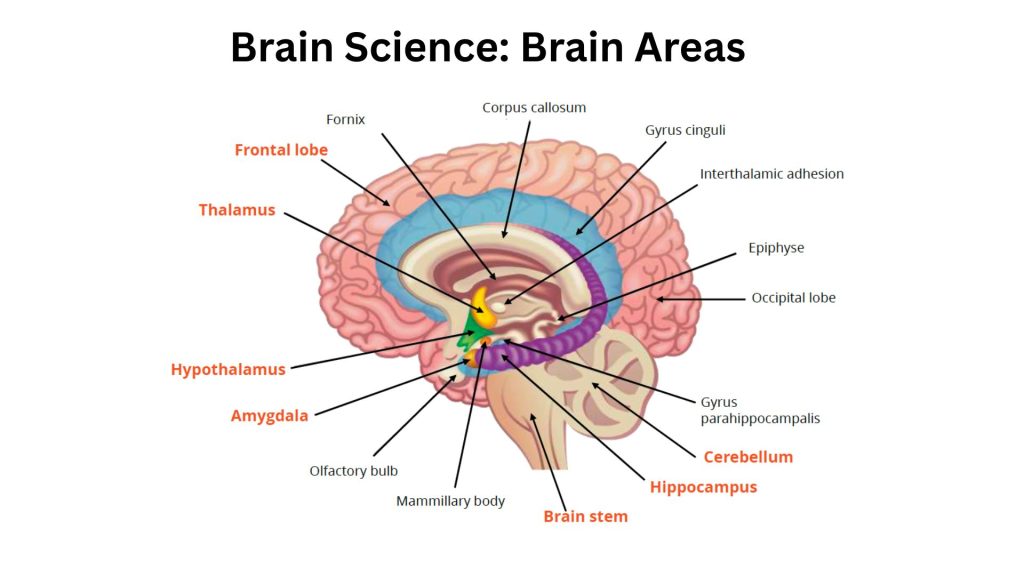
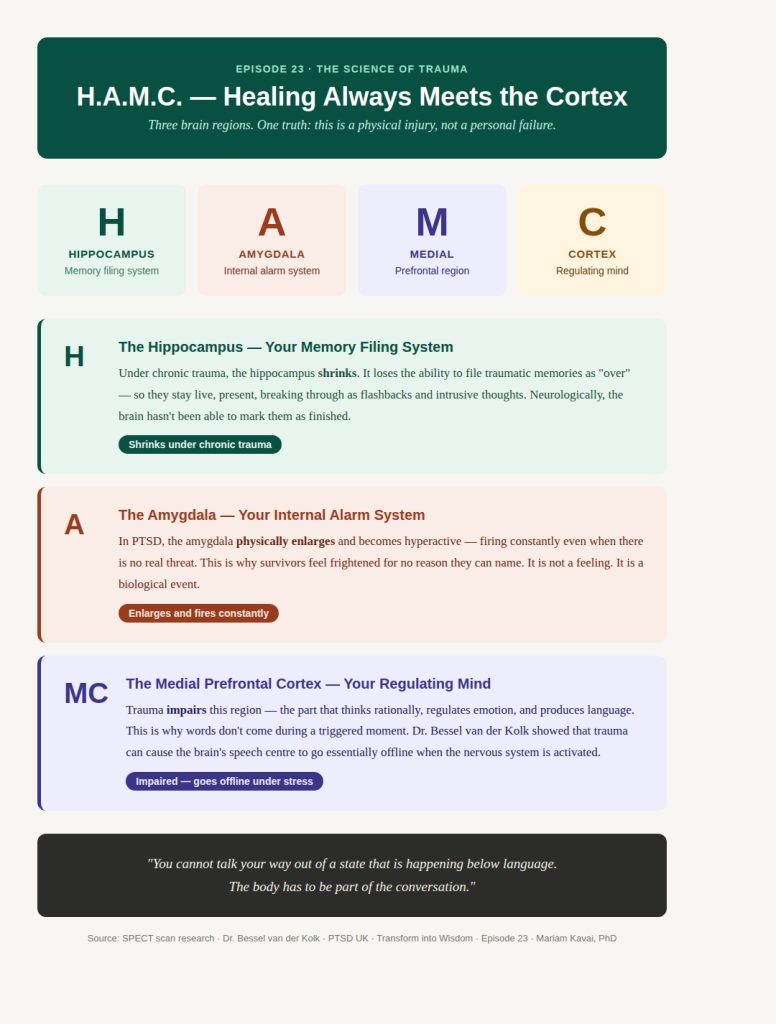
No. What you are dealing with is an injury. An injury to the brain. And it shows up in three critical areas. I want to give you a simple way to remember them. I call it H.A.M.C. — Healing Always Meets the Cortex.
H — The Hippocampus: Your Memory Filing System
The hippocampus helps your brain form memories and — crucially — file them correctly in time. It’s what allows you to experience something painful and eventually move it into the past.
Under chronic trauma, the hippocampus shrinks. And when it can’t do its job, traumatic memories don’t get filed as ‘over.’ They stay live. They stay present. They break through as flashbacks, intrusive thoughts, and a sense of reliving — because neurologically, the brain hasn’t been able to mark them as finished.
A — The Amygdala: Your Internal Alarm System
The amygdala is the part of your brain responsible for detecting threat and triggering a fear response. In a healthy nervous system, it fires when there’s genuine danger — and then settles. But in PTSD, the amygdala physically enlarges. It becomes hyperactive.
It fires constantly, even when there is no real threat, flooding your body with fear signals around the clock.
This is why so many survivors describe feeling frightened for no reason they can name. It’s not a feeling — it’s a biological event.
M + C — The Medial Prefrontal Cortex: Your Regulating Mind
This is the part of your brain that thinks rationally, regulates emotion, and — importantly — produces language. It’s what allows you to pause, reflect, and respond rather than react.
Trauma impairs it. Which is why survivors often say, “I know what happened, but I can’t explain how I feel.” Or why, in the middle of a triggered moment, words simply don’t come.
Dr. Bessel van der Kolk’s research showed that trauma can cause the brain’s speech centre to go essentially offline when the nervous system is activated.
You cannot talk your way out of a state that is happening below language. This is why insight alone is not enough. The body has to be part of the conversation.
How Many People Are Affected by Narcissistic Abuse?
Before we go further, I want to give you some numbers — because they matter. Narcissistic abuse is more widespread than most people realize, and it is severely underrecognized in clinical settings.
Researcher Sandra Brown of the Institute for Relational Harm Reduction estimates that over 60 million Americans may be affected by a narcissistic relationship at some point in their lives. That’s not a fringe experience. That is an epidemic hiding in plain sight.
A 2024 study of 500 survivors found that 82% reported significant anxiety symptoms, and approximately 74% met criteria for C-PTSD — Complex Post-Traumatic Stress Disorder. And yet narcissistic abuse still lacks its own formalized clinical diagnosis. Survivors are frequently misclassified as having generalized anxiety or depression.
It’s worth noting that women face a two to three times higher risk of developing PTSD compared to men, with lifetime prevalence of 10 to 12 percent in women versus 5 to 6 percent in men. And given that the victims of narcissistic abuse skew significantly female, this disparity is not a coincidence.
These numbers are not just statistics to me. Each one represents a sensitive soul — like you, like me — who deserve to be seen, understood, and supported with the right information.
Part 2: What Narcissistic Abuse Does to Your Nervous System
The Nervous System Under Siege
I want you to understand something that may reframe everything you think you know about why you stayed, why you went back, why it felt so impossible to leave.
It wasn’t weakness. It was chemistry.
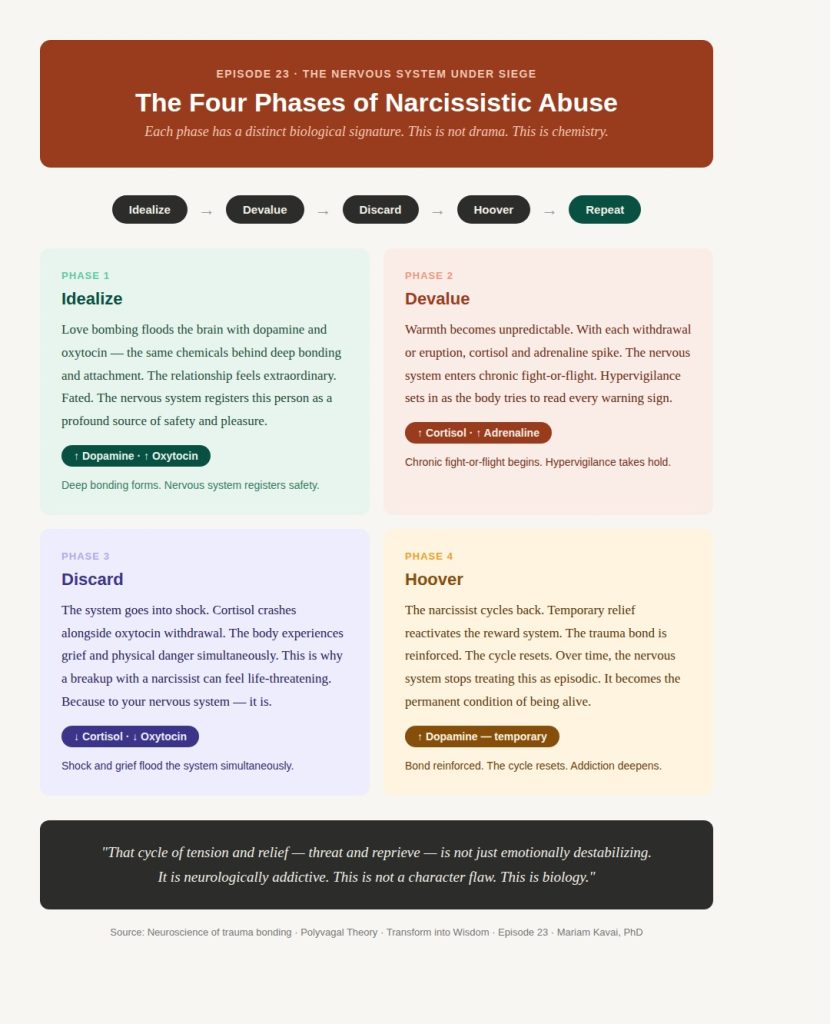
Narcissistic abuse rarely begins with cruelty. It begins with intensity. The love bombing phase — that flood of attention, adoration, mirroring — floods your brain with dopamine and oxytocin. The same chemicals involved in deep bonding, reward, and attachment.
That’s why everyone at the beginning says that the relationship feels extraordinary. Fated. Safe. Meant to be. Your nervous system registers this person as a source of profound pleasure — and begins to wire itself around that association.
And then, almost imperceptibly, something shifts. The warmth becomes unpredictable. The rules for earning love keep changing. And every time the narcissist withdraws, criticizes, or erupts — your body releases a surge of cortisol and adrenaline.
The stress response activates. And then, sometimes hours later, sometimes days — there is a repair. A return. Relief floods your system.
That cycle of tension and relief — threat and reprieve — is not just emotionally destabilizing. It is neurologically addictive. The brain begins to associate this person with both the highest highs and the most urgent need for soothing. A trauma bond forms at a chemical level, beneath the reach of conscious choice.
This is not a character flaw. This is biology.
The Four Phases of Narcissistic Abuse and What They Do to the Body
Phase 1 — Idealize: dopamine and oxytocin flood the system. Deep bonding forms. The nervous system registers safety and attachment.
Phase 2 — Devalue: cortisol and adrenaline begin to spike regularly. The nervous system enters a state of chronic fight-or-flight. Hypervigilance sets in as the body tries to read the environment for warning signs.
Phase 3 — Discard: the system goes into shock. Cortisol crashes alongside oxytocin withdrawal — and the body experiences this as grief and physical danger simultaneously. This is why a breakup with a narcissist can feel like a life-threatening emergency. Because to your nervous system, it is.
Phase 4 — Hoover: the narcissist cycles back. Temporary relief reactivates the reward system. The bond is reinforced. The cycle resets.
Over months or years of this, the nervous system stops treating the threat as episodic. It begins treating it as the permanent condition of being alive.
You cannot think your way out of a state your body has been trained into.
The Window of Tolerance Narrows
Dr. Stephen Porges, the neuroscientist behind Polyvagal Theory, describes how our nervous system is constantly and involuntarily scanning the environment through a process he calls “neuroception” — a below-conscious threat detection system.
In a healthy nervous system, this is flexible. It reads safety, relaxes, connects. It reads danger, mobilizes, protects — then returns to rest.
After prolonged narcissistic abuse, this process becomes recalibrated. The chronic unpredictability — the gaslighting, the intermittent punishment, the manipulation — teaches the body that safety is an illusion. That the person who is your source of comfort is also your source of danger.
The result is a dramatically narrowed window of tolerance. Things that seem trivial to others can tip the nervous system straight into alarm. Not because you’re overreacting. Because your body was trained, over thousands of repetitions, to treat these signals as dangerous.
This shows up as persistent hyperarousal: racing heart, shallow breathing, difficulty sleeping, a dread with no clear cause. Or, when the system becomes too exhausted to sustain that level of activation, it collapses into the opposite — the freeze state. Numbness. Dissociation. An inability to feel much of anything at all.
Many survivors cycle between these two extremes within the same day — and feel as if they have very little access to the calm, connected middle ground in between. That disconnection is not a personality trait. It is a physiological adaptation to chronic threat.
Part Three: After the Relationship — and the Road Back
Why Things Sometimes Get Harder Before They Get Better
I want to address something that confuses and frightens so many survivors — and that almost nobody prepares you for.
Symptoms of trauma often intensify after the relationship ends, not during it.
While you were inside the relationship, your nervous system was in a kind of controlled survival mode. It had learned — however painfully — how to navigate the terrain. There was a terrible logic to it. Your body had a job to do.
When that environment disappears, the nervous system doesn’t simply exhale and return to baseline. It is left holding years of accumulated stress with no immediate threat to orient around. The hypervigilance that once had a clear target now fires at everything. Old memories press forward, demanding to be processed at last.
If you have lived this, you may have wondered whether you were getting worse. Whether leaving had somehow broken something.
What you were actually experiencing was the beginning of your nervous system trying to unwind. It is not regression. It is the first trembling movement toward repair.
Healing does not mean staying permanently calm. It means developing flexibility — the capacity to move between states, and to find your way back.
Why the Central Nervous System Is the Key to Healing
Here is the core truth of everything we’ve explored today — and I want you to hear it clearly.
Understanding what happened to you is necessary. Naming the patterns, reading the books, doing the therapy — all of it matters. All of it is part of the journey.
But if your nervous system remains in a chronic state of threat activation, cognitive clarity will keep slipping away. Insights will dissolve the moment something triggers your body back into alarm. Boundaries will collapse under stress.
The healing you’ve done in your mind won’t have anywhere to land — because the body hasn’t caught up yet.
This is not a failure. This is biology.
The good news — and I mean this with my whole heart — is that the nervous system is not a fixed system. It is a living, adaptive one. Governed by the same neuroplasticity that allowed it to be shaped by trauma, it retains the capacity to learn safety.
To be recalibrated. To build, over time and through repeated experience, a new internal map.
One in which rest is possible. One in which connection is not automatically dangerous. One in which your body is no longer standing guard against a threat that no longer exists.
What Nervous System Healing Looks Like in Practice
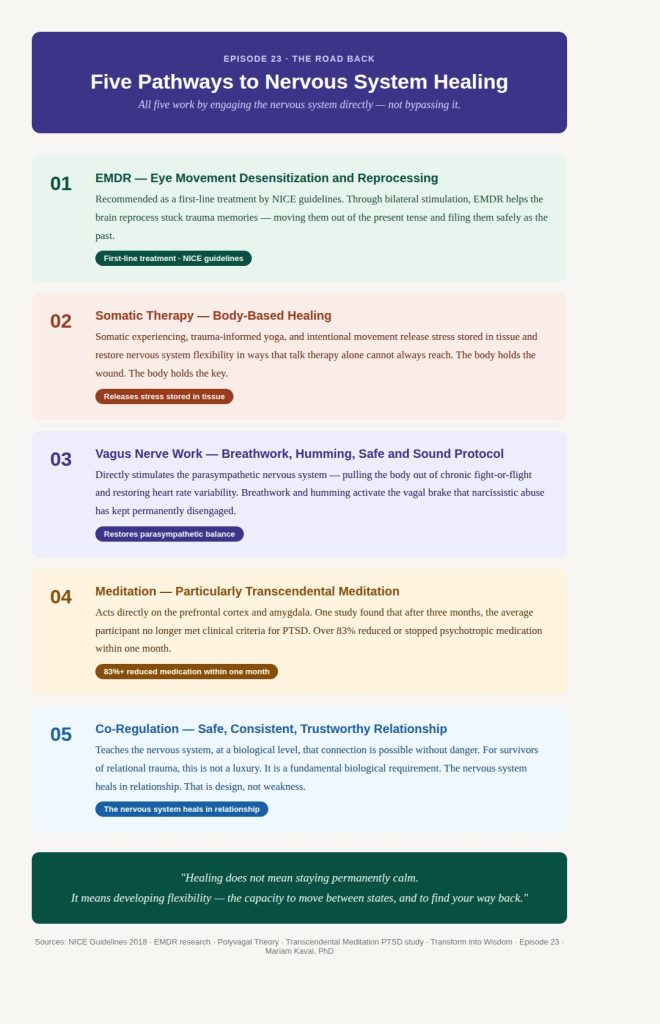
So what does that recalibration actually look like? The research and clinical evidence point to five key pathways — all of which work by engaging the nervous system directly, rather than bypassing it.
EMDR — Eye Movement Desensitization and Reprocessing — is recommended as a first-line treatment (by NICE guidelines). Through bilateral stimulation, it helps the brain reprocess ‘stuck’ trauma memories, moving them out of the present tense and filing them safely as the past.
Somatic therapy — body-based modalities like somatic experiencing, trauma-informed yoga, and intentional movement — work by releasing stress stored in tissue and restoring nervous system flexibility in ways that talk therapy alone cannot always reach.
Vagus nerve work — breathwork, humming, cold exposure, the Safe and Sound Protocol — directly stimulates the parasympathetic system, pulling the body out of chronic fight-or-flight and restoring heart rate variability.
Meditation — particularly transcendental meditation — acts directly on the prefrontal cortex and amygdala. One study found that after three months, the average participant no longer met clinical criteria for PTSD. Over 83% reduced or stopped psychotropic medication within one month.
Co-regulation — being in safe, consistent, trustworthy relationship — teaches the nervous system, at a biological level, that connection is possible without danger. For survivors of relational trauma, this is not a luxury. It is a fundamental biological requirement. The nervous system heals in relationship. That is design, not weakness.
Closing
If you are somewhere on this journey — whether you are still inside a relationship you’re beginning to name, or months out and wondering why you still don’t feel free, or years past it and finally making sense of symptoms you’ve carried for a long time — I want you to hear this.
What happened to you was real. The damage was real. And the biology that is keeping you stuck is real. Measurable. Visible on brain scans. Documented in peer-reviewed research.
You are not broken. You are not weak. You are not failing to heal fast enough.
You are a sensitive soul who was deeply betrayed, and in order to survive, you treat the world as dangerous. And you are now doing the slow, profound, necessary work of teaching yourself — teaching your body — something different.
That body that has been carrying all of this? It has been working so hard to protect you. Honor it. Be patient with it. And know that it is capable of learning safety again.
You are not just surviving. You are becoming. A new you is being forged from the ashes of your old life. And just like the phoenix, you will rise from the ashes.
That work is worth doing.
Stay empowered and true to yourself.
— Mariam
Key Statistics Mentioned
Over 60 million Americans estimated to be affected by narcissistic relationships (Sandra Brown, Institute for Relational Harm Reduction)
82% of narcissistic abuse survivors report significant anxiety; ~74% meet criteria for C-PTSD (2024 research study, n=500)
Women face 2–3x higher risk of PTSD than men; lifetime prevalence 10–12% vs. 5–6%
20% of all trauma survivors go on to develop PTSD or C-PTSD
83%+ of participants in one study reduced or stopped psychotropic medication after one month of transcendental meditation
Resources & Sources
PTSD UK — The Science and Biology of PTSD: ptsduk.org
Dr. Stephen Porges — Polyvagal Theory (2022, Frontiers in Integrative Neuroscience)
Dr. Bessel van der Kolk — The Body Keeps the Score
Institute for Functional Medicine — Understanding PTSD from a Polyvagal Perspective
Sandra Brown — Institute for Relational Harm Reduction and Public Pathology Education